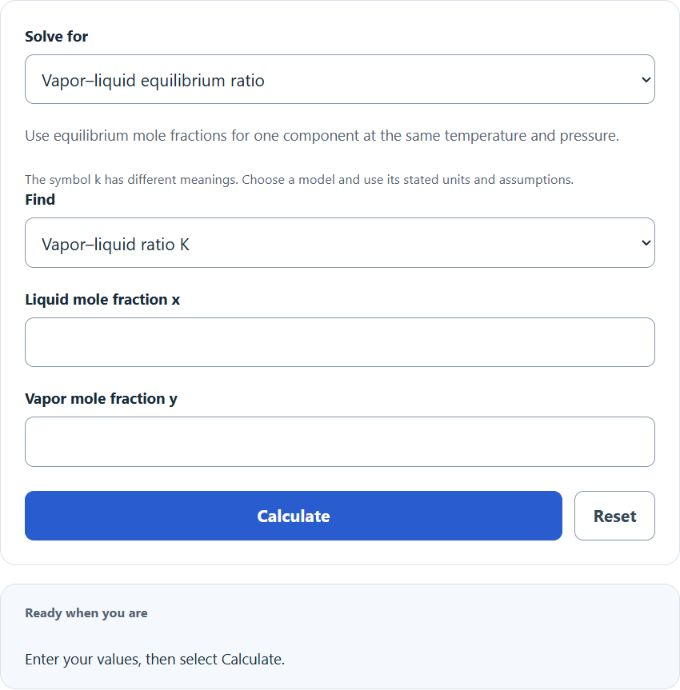
Calculate a vapor–liquid composition ratio, spring constant, slab thermal conductivity, chemical concentration quotient or first-order decay constant. These different uses of k have different units and assumptions.
- All Construction Calculators
- Rate Constant Calculator
- Molar Volume Calculator
- Equilibrium Constant Calculator
- Henry’s Law Constant Calculator
K Value Formula
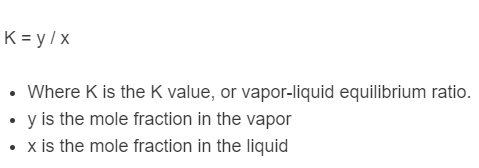
The following formula is used to calculate a k value.
- Where K is the K value, or vapor-liquid equilibrium ratio.
- y is the mole fraction in the vapor
- x is the mole fraction in the liquid
To calculate this vapor–liquid K value, divide the component’s vapor mole fraction by its positive liquid mole fraction, using equilibrium compositions at the same temperature and pressure. Fractions must lie between 0 and 1. The other calculator modes use F = kx, q = kAΔT/L, the equilibrium concentration quotient, or first-order decay; they do not share this phase-ratio formula.
K Value Definition
In the vapor–liquid context used in the formula above, a component’s K value is its equilibrium vapor mole fraction divided by its equilibrium liquid mole fraction at the same temperature and pressure. This dimensionless composition ratio is not generally identical to a dimensioned Henry-law constant. The same letter also labels unrelated spring, thermal and kinetic quantities. See Penn State’s formulation of the vapor–liquid equilibrium problem.
Can K values be negative?
A vapor–liquid composition ratio cannot be negative because mole fractions cannot be negative; a zero liquid fraction makes y/x undefined. The spring and thermal modes use positive material parameters and magnitudes. The rate mode models nonnegative first-order decay; increasing concentration is outside that model.
K Value Example
How to calculate K value?
- First, determine the mole fraction in the vapor.
Determine the mole fraction of the molecule in a vapor state.
- Next, determine the mole fraction in the liquid.
Calculate the mole fraction of the molecule in a liquid state.
- Finally, calculate the K Value.
Calculate the K value using the formula above.
FAQ
A mole fraction is the ratio of the number of moles of one component of a solution to the total moles of all components.