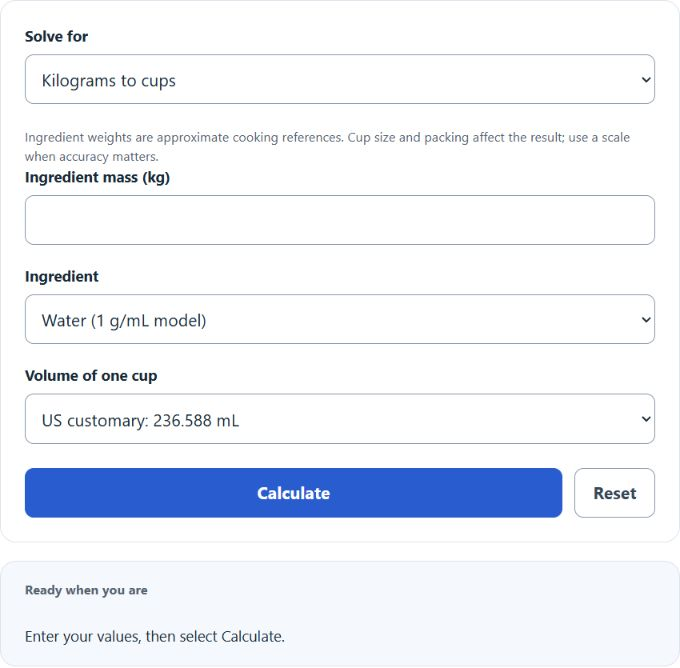
Convert kilograms to cups or cups to kilograms using ingredient-specific density, common kitchen ingredients, custom density, and US, metric, or imperial cup sizes.
Quick overview: kilograms measure mass, while cups measure volume.
To convert kilograms to cups, first convert kilograms to grams, then divide by the ingredient’s estimated grams per cup:
cups = (kg × 1000) ÷ grams per cup
Because ingredients have different densities, the result changes depending on whether you are measuring water, flour, sugar, butter, honey, rice, or another ingredient.
- Water: 1 kg ≈ 4.23 cups
- All-purpose flour: 1 kg ≈ 8.33 cups
- Granulated sugar: 1 kg ≈ 5.00 cups
- Honey: 1 kg ≈ 2.94 cups
- mL To kg
- Inches To Quarts Calculator
- Conversion Factor Calculator
- Stowage Factor Calculator
- All Unit Converters
kg to Cups Formula
The following formula is used to convert a weight in kilograms to an approximate volume in cups for a specific ingredient.
Variables:
- Cups is the approximate volume in cups
- kg is the weight in kilograms
- 1000 converts kilograms to grams
- GPC is the ingredient’s grams per cup value
To calculate cups from kilograms, multiply the number of kilograms by 1000 to convert to grams, then divide by the ingredient’s estimated grams per cup. Since each ingredient has a different density, the grams per cup value will change depending on what you are measuring.
Approximate reference weights per US customary cup (236.5882365 mL) are water at 236.6 g using a 1 g/mL model, all-purpose flour at 120 g, granulated sugar at 200 g, packed brown sugar at 220 g, butter at 227 g, honey at 340 g, and an illustrative uncooked white-rice value of 195 g. Other cup sizes are scaled by volume; use product-specific density when available.
What is kg to Cups?
The kg to cups conversion changes a measurement of mass into an estimated measurement of volume. Because cups measure how much space an ingredient takes up, and kilograms measure how much the ingredient weighs, the conversion depends on the ingredient being used. A kilogram of flour occupies more cups than a kilogram of honey because flour is less dense, while honey is much heavier per cup.
This is why kitchen conversions between kilograms and cups are always approximate unless the ingredient’s density is known. The calculator above uses common cooking reference weights for several frequently used ingredients to provide a practical estimate.
How to Convert kg to Cups?
The following steps outline how to convert kilograms to cups.
- First, determine the weight in kilograms.
- Next, identify the ingredient you are measuring.
- Find the estimated grams per cup value for that ingredient.
- Convert kilograms to grams by multiplying by 1000.
- Divide the total grams by the grams per cup value using the formula Cups = (kg × 1000) / GPC.
- Check your answer with the calculator above.
Example Problem:
Use the following variables as an example problem to test your knowledge.
Weight = 1.5 kg
Ingredient = All-purpose flour
Grams per cup = 120
Cups = (1.5 × 1000) / 120 = 12.5 cups
kg to Cups Conversion Table
The table below lists example conversions for 1 kilogram of several common ingredients using US customary cup estimates (236.5882365 mL). Values are rounded to two decimal places.
| Ingredient | Approx. grams per cup | 1 kg in cups (approx.) |
|---|---|---|
| Water | 236.6 g | 4.23 cups |
| All-purpose flour | 120 g | 8.33 cups |
| Granulated sugar | 200 g | 5.00 cups |
| Packed brown sugar | 220 g | 4.55 cups |
| Butter | 227 g | 4.41 cups |
| Honey | 340 g | 2.94 cups |
| Uncooked white rice | 195 g | 5.13 cups |
In real recipes, cup measurements can vary slightly depending on packing, humidity, and measuring style, so these conversions should be treated as close estimates rather than exact values.