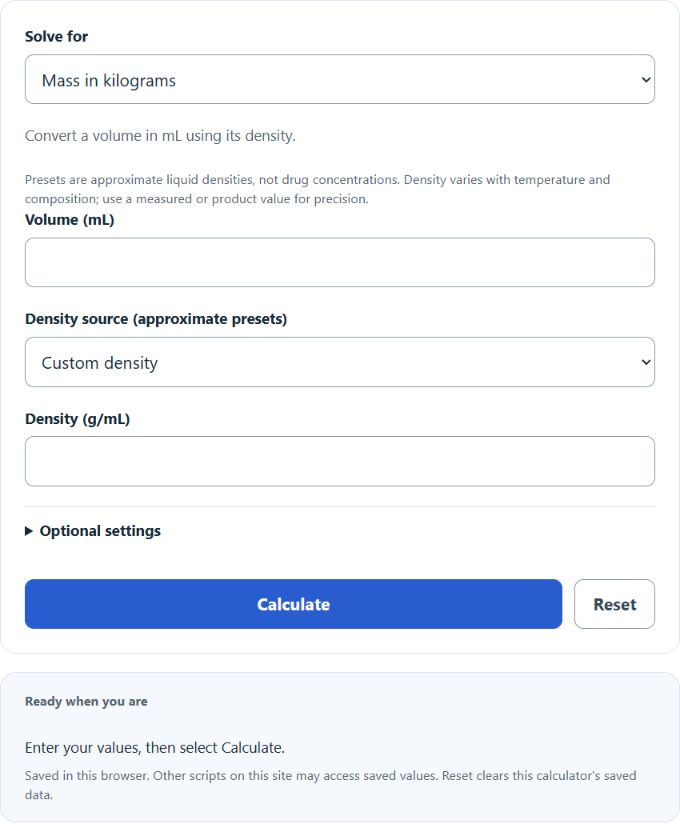
Convert mL to kg or kg to mL for water, milk, oil and other liquids using density, with custom liquid options and unit conversions.
- All Unit Converters
- mL to mg Calculator
- mL to kg Converter
- L to kg Water Conversion Calculator
- kg to L Converter
- g to mL Water Conversion Calculator
- Mass to Volume Calculator
mL to kg Formula
The following formula converts a volume in milliliters to a mass in kilograms using density:
Variables:
- ml is the volume in milliliters
- kg is the mass in kilograms
- d is the density of the liquid in grams per milliliter (g/mL)
Multiply the volume by the liquid’s density, then divide by 1,000 to shift from grams to kilograms. For pure water at room temperature (about 20 to 25 degrees Celsius), density is approximately 0.997 to 0.998 g/mL, so 1 mL of water is very close to 0.001 kg. For other liquids, the density value changes the result significantly. Mercury, for example, has a density of 13.534 g/mL, meaning 100 mL of mercury weighs roughly 1.353 kg, while 100 mL of gasoline (density 0.74 g/mL) weighs only 0.074 kg.
Milliliters to Kilograms Conversion Table (Water)
| Milliliters (mL) | Kilograms (kg) |
|---|---|
| 1 | 0.001 |
| 5 | 0.005 |
| 10 | 0.010 |
| 15 | 0.015 |
| 30 | 0.030 |
| 50 | 0.050 |
| 75 | 0.075 |
| 100 | 0.100 |
| 150 | 0.150 |
| 200 | 0.200 |
| 237 | 0.237 |
| 250 | 0.250 |
| 300 | 0.300 |
| 350 | 0.350 |
| 400 | 0.400 |
| 473 | 0.473 |
| 500 | 0.500 |
| 750 | 0.750 |
| 1,000 | 1.000 |
| 2,000 | 2.000 |
| Assumes pure water at approximately 4 degrees C (density = 1.00 g/mL). 1 mL = 0.001 kg. | |
500 mL of Common Liquids Converted to Kilograms
The table below shows how much 500 mL of different liquids weighs in kilograms. Because each substance has a different density, the same 500 mL volume produces a wide range of masses.
| Liquid | Density (g/mL) | 500 mL in kg |
|---|---|---|
| Gasoline | 0.740 | 0.370 |
| Acetone | 0.784 | 0.392 |
| Ethanol | 0.789 | 0.395 |
| Isopropyl Alcohol | 0.786 | 0.393 |
| Diesel Fuel | 0.832 | 0.416 |
| Olive Oil | 0.918 | 0.459 |
| Vegetable Oil | 0.920 | 0.460 |
| Coconut Oil (melted) | 0.925 | 0.463 |
| Water (pure, 20 °C) | 0.998 | 0.499 |
| Sea Water | 1.025 | 0.513 |
| Whole Milk | 1.030 | 0.515 |
| Propylene Glycol | 1.040 | 0.520 |
| Ethylene Glycol (antifreeze) | 1.113 | 0.557 |
| Glycerin | 1.260 | 0.630 |
| Honey | 1.420 | 0.710 |
| Sulfuric Acid (concentrated) | 1.840 | 0.920 |
| Mercury | 13.534 | 6.767 |
| Density values are approximate at roughly 20 degrees C and 1 atm. Actual values vary with temperature and purity. | ||
Water Density by Temperature
Water’s density is not a fixed constant. It reaches a peak of 0.99997 g/mL at 3.98 degrees Celsius, then decreases in both directions as the temperature rises toward boiling or drops toward freezing. For most everyday conversions, using 1.00 g/mL introduces less than 0.4% error at room temperature, but for laboratory, pharmaceutical, or engineering work, the temperature-adjusted value from the table below should be used.
| Temperature (degrees C) | Density (g/mL) | 1,000 mL in kg |
|---|---|---|
| 0 (just above freezing) | 0.99984 | 0.99984 |
| 4 (maximum density) | 0.99997 | 0.99997 |
| 10 | 0.99970 | 0.99970 |
| 15 | 0.99910 | 0.99910 |
| 20 | 0.99821 | 0.99821 |
| 25 (room temperature) | 0.99705 | 0.99705 |
| 30 | 0.99565 | 0.99565 |
| 37 (body temperature) | 0.99333 | 0.99333 |
| 40 | 0.99222 | 0.99222 |
| 50 | 0.98804 | 0.98804 |
| 60 | 0.98320 | 0.98320 |
| 70 | 0.97778 | 0.97778 |
| 80 | 0.97179 | 0.97179 |
| 90 | 0.96531 | 0.96531 |
| 100 (boiling at sea level) | 0.95835 | 0.95835 |
| Values from the IAPWS-95 formulation for the thermodynamic properties of water. Measured at 1 standard atmosphere (101.325 kPa). | ||
At 100 degrees Celsius, 1,000 mL of water weighs about 0.958 kg rather than a full kilogram. That 4.2% difference matters when scaling recipes in commercial kitchens that measure boiling water by volume, calibrating laboratory volumetric glassware at non-standard temperatures, or performing heat balance calculations in HVAC and chemical process engineering.
What is mL to kg?
Milliliters (mL) measure volume, the amount of three-dimensional space a liquid occupies. Kilograms (kg) measure mass, the quantity of matter in that liquid. These two units describe fundamentally different physical properties, so converting between them requires a third piece of information: density, which tells you how much mass is packed into each unit of volume.
The reason this conversion is not a simple ratio is that liquids vary enormously in density. 500 mL of honey (density 1.42 g/mL) weighs 0.710 kg, while 500 mL of gasoline (density 0.74 g/mL) weighs only 0.370 kg. Even the same liquid changes density as its temperature shifts. Water at 4 degrees Celsius is about 4.3% denser than water at 100 degrees Celsius, a difference large enough to affect dosing calculations in pharmacology, volumetric calibration in analytical chemistry, and thermal sizing in process engineering.
The density of water at room temperature (roughly 0.998 g/mL) is close enough to 1.00 that many quick conversions treat mL and grams as interchangeable. This shortcut works well for cooking, casual hydration tracking, and rough estimates. It breaks down, however, for saltwater (1.025 g/mL), milk (1.03 g/mL), concentrated syrups, or any liquid that departs meaningfully from pure water. In those cases, always use the measured density value in the formula.
Why Density Varies
Three factors change a liquid’s density and therefore change the ml to kg conversion result. Temperature is the most common variable. As temperature rises, molecules move faster and spread apart, reducing the mass contained in each milliliter. Dissolved solids also raise density. Sea water is denser than fresh water because of the roughly 35 grams of salt per liter dissolved in it. Dead Sea water, with around 340 grams of dissolved minerals per liter, has a density near 1.24 g/mL. Pressure has a smaller effect on liquids than on gases, but at extreme pressures found in deep ocean environments or industrial hydraulic systems, liquid density increases measurably. At the bottom of the Mariana Trench (about 1,086 bar), water density rises to approximately 1.050 g/mL compared to 1.025 g/mL at the surface.
Where This Conversion is Used
Fluid density converts solution volume to total solution mass; it does not determine the mass of a dissolved drug. Medication or solute arithmetic requires the verified labeled concentration, such as mg/mL, and appropriate clinical guidance. In analytical chemistry, volumetric glassware is calibrated by weighing the water it contains at a known temperature, then back-calculating volume from the temperature-specific density. Food manufacturing scales recipes from test batches measured in milliliters to production batches tracked by weight in kilograms. Fuel logistics use the conversion to reconcile volume measurements at the pump (liters or gallons) with mass measurements used for energy content calculations and transportation billing, since fuel is sold by volume but its energy output correlates with mass. Concrete batching plants measure water additions by volume but track total batch weight in kilograms, adjusting for the temperature of the mixing water to keep the water-to-cement ratio precise.