Calculate Kirchhoff’s Voltage Law for series circuits, resistor voltage drops, LED resistors, and unknown voltages or currents in loops.
- All Physics Calculators
- RMS Voltage (VRMS) Calculator
- Voltage Divider Calculator
- Peak Voltage Calculator
- Ripple Voltage Calculator
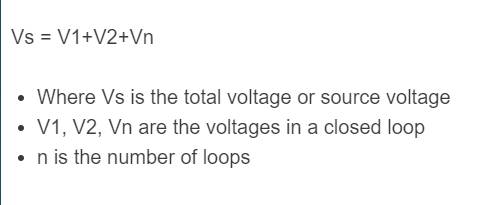
Kirchhoff’s Voltage Law Formula
- Where Vk is the voltage rise or drop across the k-th element in the loop (with a consistent sign convention)
- n is the number of voltage terms (elements) included in the loop equation
To calculate an unknown voltage using Kirchhoff’s Voltage Law, choose a loop direction and sign convention (for example, treat voltage drops as positive and voltage rises as negative), then solve so that the algebraic sum of voltages around the loop equals zero.
Kirchhoff’s Voltage Law Definition
Kirchhoff’s Voltage Law (KVL) states that the algebraic sum of all voltage rises and drops around any closed loop in a circuit is zero. Equivalently, the total of the voltage rises equals the total of the voltage drops (using a consistent sign convention).
Example
How to calculate Kirchhoff’s voltage law?
- First, determine the voltages across each element.
Choose a loop direction and measure (or calculate) the voltage across each component in that loop, keeping track of polarity/sign.
- Next, apply KVL and solve for the unknown.
Sum the voltages algebraically around the loop so that their total equals 0, then rearrange to find the missing voltage.
FAQ
Kirchhoff’s voltage law states that the algebraic sum of all voltages around any closed loop in a circuit equals 0.