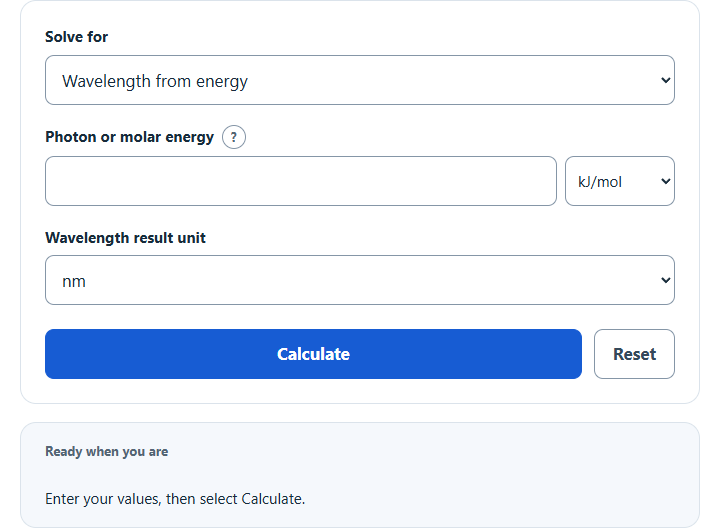
Calculate wavelength from kJ/mol energy or find energy from wavelength, with photon energy, frequency, and spectrum region conversions.
Related Calculators
- Electron Affinity Calculator
- Heat of Fusion Calculator
- Eyring Equation Calculator
- Bond Length Calculator
- All Chemistry Calculators
Calculator Functions
| Function | What it does | What it requires |
|---|---|---|
| Wavelength from energy | Converts a photon energy in kJ/mol into a wavelength in nm | Requires the energy in kJ/mol, J/mol, eV per photon or J per photon |
| Energy from wavelength | Converts a wavelength in nm into kJ/mol | Requires the vacuum wavelength in nm, m, cm or µm |
| Photon energy from molar energy | Finds the energy of one photon in joules from an energy per mole | Requires the molar photon energy in kJ/mol |
| Frequency from wavelength | Finds the frequency of light of a given wavelength | Requires the vacuum wavelength in nm, m, cm or µm |
| Wavelength from frequency | Finds the wavelength of light of a given frequency | Requires the frequency in Hz, kHz, MHz, GHz or THz |
Each function has a result unit setting where the answer can take more than one unit. Every result also lists the matching wavelength, frequency, energy per photon in joules and electronvolts, molar energy and the approximate region of the spectrum.
kJ/mol to Wavelength Formulas
| λ | Wavelength in vacuum (m). Multiply by 109 for nm |
| h | Planck constant, 6.62607015 × 10⁻³⁴ J·s [1] |
| c | Speed of light in vacuum, 299,792,458 m/s [2] |
| NA | Avogadro constant, 6.02214076 × 10²³ per mole [3] |
| Emol | Energy of one mole of photons (J/mol). Multiply kJ/mol by 1,000 |
All three constants are exact by definition, so the formula reduces to one number: λ in nm = 119,626.57 ÷ energy in kJ/mol.
Wavelength from energy
The formula above applies directly. For 246 kJ/mol, λ = 119,626.57 ÷ 246 = 486.3 nm, which is in the visible range. A photon energy of 157 kJ/mol is 762.0 nm and 479 kJ/mol is 249.7 nm. An energy entered in eV or J per photon skips the Avogadro constant: λ = h × c ÷ E.
| kJ/mol | Wavelength (nm) | Region |
|---|---|---|
| 50 | 2,392.5 | Infrared |
| 100 | 1,196.3 | Infrared |
| 150 | 797.5 | Infrared |
| 200 | 598.1 | Visible |
| 250 | 478.5 | Visible |
| 300 | 398.8 | Visible |
| 400 | 299.1 | Ultraviolet |
| 500 | 239.3 | Ultraviolet |
| 600 | 199.4 | Ultraviolet |
| 800 | 149.5 | Ultraviolet |
| 1,000 | 119.6 | Ultraviolet |
Energy from wavelength
The same number works in reverse: kJ/mol = 119,626.57 ÷ wavelength in nm. Green light at 532 nm carries 119,626.57 ÷ 532 = 224.9 kJ/mol.
Photon energy from molar energy
For 250 kJ/mol, E = 250,000 ÷ 6.02214076 × 1023 = 4.151 × 10⁻¹⁹ J per photon. Dividing by the elementary charge, 1.602176634 × 10⁻¹⁹ C [4], gives 2.591 eV.
Frequency from wavelength
A wavelength of 500 nm has f = 299,792,458 ÷ (500 × 10−9) = 5.996 × 10¹⁴ Hz, or 599.6 THz. The photon energy follows from E = h × f.
Wavelength from frequency
A frequency of 600 THz has λ = 299,792,458 ÷ (600 × 1012) = 4.997 × 10⁻⁷ m, or 499.7 nm.
Limits of This Estimate
- The wavelength is the vacuum wavelength. In air, water or glass the wavelength is shorter by the refractive index, while the frequency and energy stay the same.
- The energy is that of light: one photon, or one mole of photons. A bond energy or reaction energy in kJ/mol converts to the wavelength whose photons carry that much energy, which is not always the wavelength a molecule absorbs.
- The spectrum labels use approximate bands, with visible light set at 380 to 740 nm. Other references end the visible range at about 700 nm [5].
Sources
- National Institute of Standards and Technology, CODATA Value: Planck constant: exact value of h
- National Institute of Standards and Technology, CODATA Value: speed of light in vacuum: exact value of c
- National Institute of Standards and Technology, CODATA Value: Avogadro constant: exact value of the Avogadro constant
- National Institute of Standards and Technology, Meet the Constants: value of the elementary charge
- NASA Science, Visible Light: wavelength range of visible light