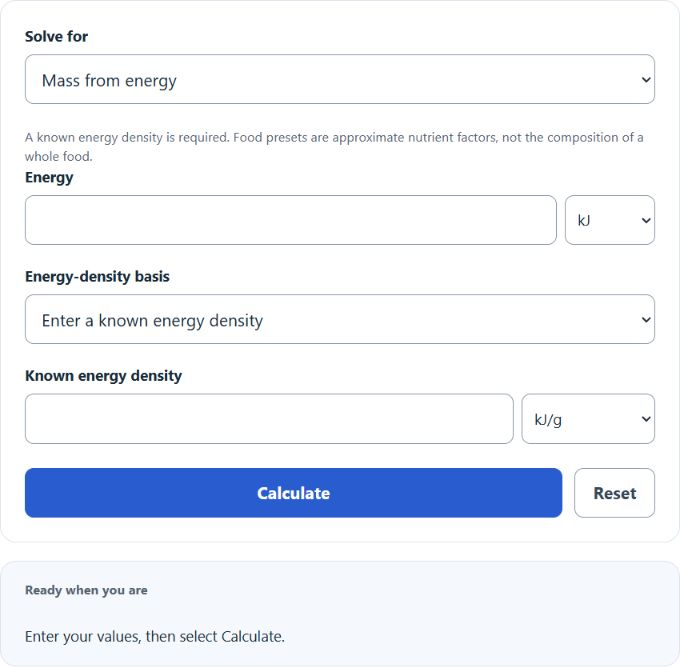
Calculate grams from kilojoules and energy density, or find energy and kJ per gram from mass with support for nutrition label units.
- All Unit Converters
- kJ to Calories Calculator
- Grams to Joules Calculator
- Grams to Calories Calculator
- Energy Density Calculator
- kJ to kW Calculator
kJ to Grams Formula
The following formula is used to calculate the grams for a given amount of kilojoules and energy per gram.
Variables:
- g is the grams
- Kj is the kilojoules
- E is the energy per gram in kilojoules per gram
To calculate the grams, divide the kilojoules by the energy per gram.
| Kilojoules (kJ) | Grams (g) |
|---|---|
| 10 | 0.588 |
| 20 | 1.176 |
| 30 | 1.764 |
| 50 | 2.941 |
| 75 | 4.412 |
| 100 | 5.882 |
| 120 | 7.059 |
| 150 | 8.824 |
| 200 | 11.765 |
| 250 | 14.706 |
| 300 | 17.647 |
| 350 | 20.588 |
| 400 | 23.529 |
| 500 | 29.412 |
| 600 | 35.294 |
| 750 | 44.118 |
| 1000 | 58.824 |
| 1500 | 88.235 |
| 2000 | 117.647 |
| 2500 | 147.059 |
| *Assumes energy per gram = 17.00 kJ/g (typical for carbohydrate/protein). Formula: grams = kilojoules ÷ (kJ/g). | |
What is kJ to Grams?
kJ to grams is a conversion that allows you to determine the mass of a substance based on its energy content and the energy per gram. For a food, use its labeled or otherwise known energy density. Nutrient presets are approximate; a whole food need not have the energy density of one pure nutrient. There is no universal kJ-to-grams factor.
How to Calculate kJ to Grams?
The following steps outline how to calculate kJ to grams.
- First, determine the kilojoules (Kj).
- Next, determine the energy per gram (E).
- Finally, calculate the grams using the formula g = Kj / E.
- After inserting the values and calculating the result, check your answer with the calculator above.
Example Problem :
Use the following variables as an example problem to test your knowledge.
Kilojoules (Kj) = 500
Energy per gram (E) = 2.5 kJ/g