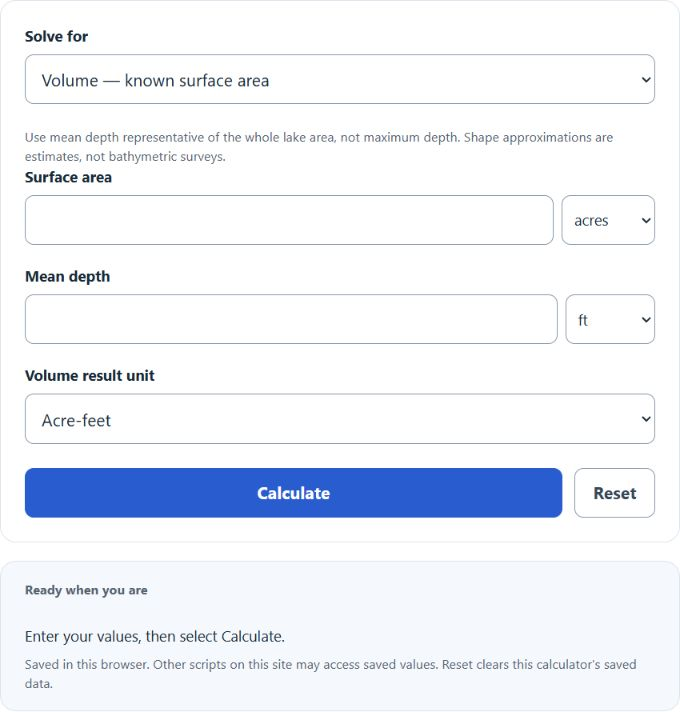
Calculate lake volume from surface area and average depth, estimate area from rectangular or elliptical dimensions, or solve for area or depth in metric and US units.
Related Calculators
- Hydraulic Horsepower Calculator
- Formation Pressure Calculator
- Weight to Force Calculator
- Water Pressure Elevation Calculator
- All Physics Calculators
Lake Volume Formula
The lake volume calculator multiplies surface area by representative mean depth. Use a known area or a rectangular, elliptical or circular plan estimate; the inverse modes solve for area or mean depth. The circular formulas below are one special case. Shape and depth estimates are not bathymetric surveys and should be verified before treatment or engineering decisions.
In these circular-case equations, the diameter and average depth are measured in feet. The first formula gives lake volume in cubic feet, and the second converts that result to US gallons.
Variable Definitions
| Variable | Meaning |
|---|---|
| D | Full lake diameter in the circular case |
| davg | Average lake depth |
| Vft³ | Lake volume in cubic feet |
| Vgal | Lake volume in US gallons |
How to Calculate Lake Volume
- Choose an area method. Enter known surface area, full length and width for a rectangle or ellipse, or full diameter for a circle.
- Estimate the average depth. Use representative, appropriately area-weighted soundings across shallow and deep portions. A simple average from biased sampling is not necessarily the whole-lake mean.
- Find the surface area. Use known area, LW for a rectangle, πLW/4 for an ellipse, or πD²/4 for a circle.
- Multiply by average depth. This gives the lake volume in cubic feet.
- Convert units if needed. The calculator can express the result in gallons, liters, or cubic meters.
Example
If a lake has a diameter of 500 feet and an average depth of 30 feet, its estimated volume in gallons is:
That means the lake holds about 44.06 million US gallons of water.
Common Conversions
After finding the lake volume in cubic feet, you can convert it to other common volume units using the following relationships:
| Conversion | Formula |
|---|---|
| Cubic feet to US gallons | Vgal = Vft³ × 7.48052 |
| Cubic feet to liters | VL = Vft³ × 28.3168466 |
| Cubic feet to cubic meters | Vm³ = Vft³ × 0.0283168466 |
Important Assumptions
- Known-area mode imposes no plan shape. Dimension modes approximate the chosen rectangle, ellipse or circle.
- It uses average depth, not maximum depth.
- The result is an estimate, which is appropriate for planning and screening calculations.
- If the shoreline is irregular, the true volume may differ from the chosen plan-shape estimate.
For Irregular Lakes
If the lake is not close to circular, a better method is to estimate the lake’s surface area directly and multiply by average depth:
Here, A is the lake surface area and davg is the average depth. This approach is often more accurate for natural lakes with uneven shorelines, coves, or long narrow shapes.
Tips for Better Accuracy
- Take depth readings at several evenly spaced points instead of relying on one or two measurements.
- Use the same unit system throughout the calculation before converting the final answer.
- Measure during a normal water level if the lake depth changes seasonally.
- For engineered ponds or reservoirs, use surveyed dimensions whenever available.
- For large lakes, dividing the area into sections and averaging each section can improve the estimate.
Why Lake Volume Matters
Knowing lake volume is useful for estimating water supply, sizing pumps and aeration systems, planning dredging, calculating chemical or dye treatment amounts, evaluating evaporation losses, and managing fisheries or irrigation storage. Even a simple estimate can be valuable when making operational decisions.