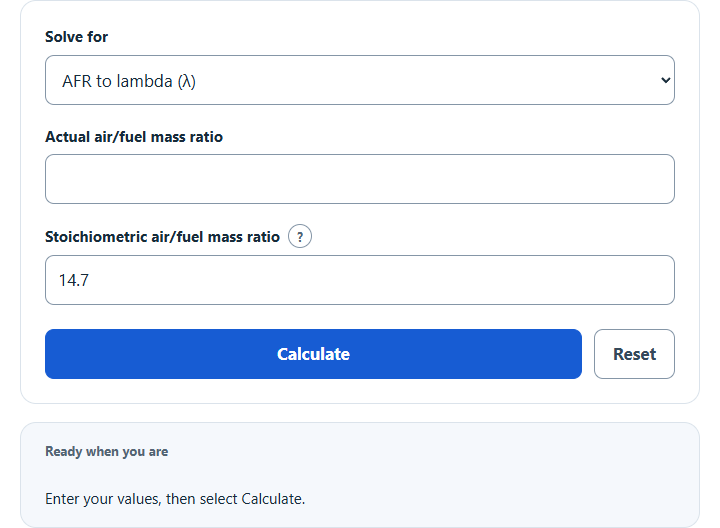
Convert AFR to lambda or lambda to AFR for gasoline, E85, diesel and other fuels, with equivalence ratio, or find air-fuel ratio from air and fuel mass.
Related Calculators
- BSFC (Brake Specific Fuel Consumption) Calculator
- MAF To HP Calculator
- Dyno Correction Calculator
- Fuel Time Calculator
- All Automotive Calculators
Calculator Functions
| Function | What it does | What it requires |
|---|---|---|
| AFR to lambda (λ) | Finds lambda from a measured air/fuel ratio | Requires the actual air/fuel mass ratio and the stoichiometric air/fuel mass ratio of the fuel |
| Lambda to AFR | Converts a lambda reading to the actual air/fuel ratio | Requires lambda and the stoichiometric air/fuel mass ratio of the fuel |
| Stoichiometric AFR from AFR and lambda | Finds the stoichiometric ratio implied by a paired AFR and lambda reading | Requires the actual air/fuel mass ratio and lambda |
| AFR from air and fuel mass | Finds the air/fuel ratio from measured masses | Requires air mass and fuel mass, each in g, kg or lb |
| Air mass from AFR | Finds the air mass that goes with a fuel mass | Requires fuel mass, the air/fuel mass ratio and a result unit |
| Fuel mass from AFR | Finds the fuel mass that goes with an air mass | Requires air mass, the air/fuel mass ratio and a result unit |
The stoichiometric field starts at 14.7 for gasoline and lists E10 (14.1), E85 (9.8), ethanol (9.0), methanol (6.47), diesel (14.5), propane (15.7) and methane (17.2). Any other value can be typed in. The three lambda functions also report the equivalence ratio φ and a lambda to AFR table from 0.70 to 1.20 for the stoichiometric ratio entered. Every ratio is a mass ratio, air to one part fuel.
Lambda Air/Fuel Ratio Formulas
| λ | Lambda, the air/fuel ratio relative to stoichiometric |
| AFR | Actual air/fuel mass ratio |
| AFRst | Stoichiometric air/fuel mass ratio of the fuel, 14.7 for gasoline [2] |
| φ | Equivalence ratio, φ = 1 ÷ λ |
The equivalence ratio compares the actual fuel/air ratio with the stoichiometric fuel/air ratio [1]. Lambda makes the same comparison with air on top, which is why the two are reciprocals. At λ = 1 the mixture is stoichiometric. Below 1 it is fuel-rich (φ above 1), and above 1 it is lean (φ below 1) [1].
AFR to lambda (λ)
The main formula applies directly. A gasoline engine reading 12.5 : 1 is at λ = 12.5 ÷ 14.7 = 0.850, with φ = 1.176.
Lambda to AFR
A lambda of 0.90 on gasoline is 0.90 × 14.7 = 13.23 : 1. The same lambda on E85 at 9.8 is 8.82 : 1, so a lambda target carries across fuels while an AFR target does not.
| Lambda (λ) | Gasoline AFR (14.7) | E85 AFR (9.8) |
|---|---|---|
| 0.70 | 10.29 : 1 | 6.86 : 1 |
| 0.75 | 11.02 : 1 | 7.35 : 1 |
| 0.80 | 11.76 : 1 | 7.84 : 1 |
| 0.85 | 12.49 : 1 | 8.33 : 1 |
| 0.90 | 13.23 : 1 | 8.82 : 1 |
| 0.95 | 13.96 : 1 | 9.31 : 1 |
| 1.00 | 14.70 : 1 | 9.80 : 1 |
| 1.05 | 15.44 : 1 | 10.29 : 1 |
| 1.10 | 16.17 : 1 | 10.78 : 1 |
| 1.15 | 16.90 : 1 | 11.27 : 1 |
| 1.20 | 17.64 : 1 | 11.76 : 1 |
Stoichiometric AFR from AFR and lambda
A paired reading of 8.33 : 1 at λ = 0.85 implies a stoichiometric ratio of 9.80 : 1, which matches the E85 reference.
AFR from air and fuel mass
Both masses are converted to grams first, with 1 lb = 453.59237 g. 1,470 g of air with 100 g of fuel is 14.7 : 1.
Air mass from AFR
50 g of fuel at 14.7 : 1 needs 735 g of air.
Fuel mass from AFR
1,000 g of air at 14.7 : 1 goes with 68.03 g of fuel.
Limits of This Estimate
- The stoichiometric ratio depends on fuel composition. Published references give 14.7 for gasoline, 9 for ethanol and about 10 for E85, whose ethanol content runs from 51% to 83% [2]. The 9.8 used here for E85 and the E10, methanol, diesel, propane and methane values are rounded reference figures. These estimates are based on the best available data and estimations.
- Lambda and AFR describe mixture strength only. A ratio alone does not establish safe engine operation or a tune.
- A wideband gauge that displays AFR is converting a lambda measurement with a fixed stoichiometric value, usually 14.7. On another fuel the displayed AFR is wrong unless that value is changed, while lambda stays correct.
Sources
- Penn State University, ME 433 Lesson 04A: Combustion Part 2 (J. M. Cimbala): equivalence ratio, and what rich and lean mean
- U.S. Department of Energy, Handbook for Handling, Storing, and Dispensing E85 and Other Ethanol-Gasoline Blends (DOE/GO-102016-4854, February 2016): stoichiometric air/fuel ratios of gasoline, ethanol and E85