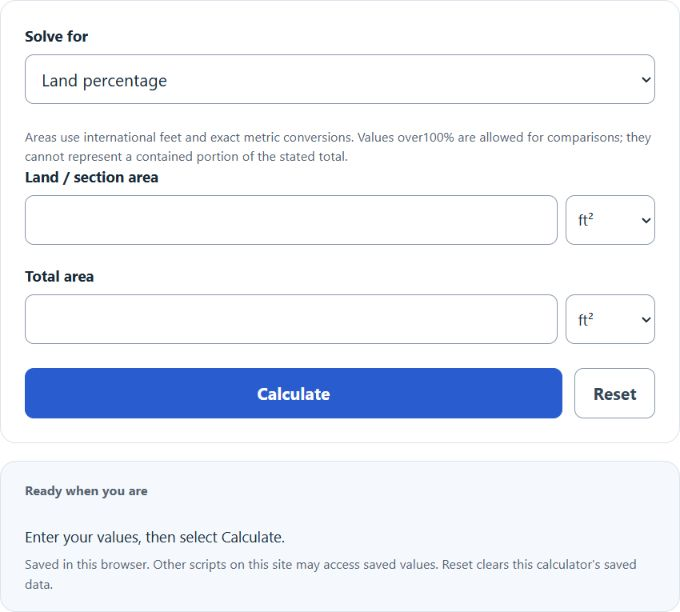
Calculate what percentage of a total land area a section covers, or find the section or total area from a percentage, in acres, hectares, m², ft² or cents.
Related Calculators
- Building Efficiency Ratio Calculator
- Land Survey Cost Calculator
- Exterior Square Footage Calculator
- Effective Area Calculator
- Gross Floor Area Calculator
- All Construction Calculators
Calculator Functions
| Function | What it does | What it requires |
|---|---|---|
| Land percentage | Finds what percent of a total area a piece of land or a section covers | Requires the land or section area and the total area, each in its own unit |
| Land / section area | Finds the area that a given percent of a total covers | Requires the land percentage, the total area and a unit for the result |
| Total area | Finds the total area when a section and its percent share are known | Requires the land or section area, the land percentage and a unit for the result |
Areas can be entered in ft², yd², m², acres, hectares, km² or cents, and the two areas do not have to use the same unit. Every result also shows the remaining area and its share when the percentage is 100 or less.
Land Percentage Formulas
| P | Land percentage (%) |
| L | Land or section area |
| T | Total area, in the same unit as L |
Land percentage
Both areas are converted to square meters before dividing, so mixed units work. A 50 m² plot on a 200 m² site is 100 × 50 ÷ 200 = 25%. A 20 hectare field on a 120 hectare farm is 16.67%, and a 10,890 ft² lot is 25% of 1 acre.
| Unit | Square meters |
|---|---|
| 1 ft² | 0.09290304 |
| 1 yd² | 0.83612736 |
| 1 acre | 4,046.8564224 |
| 1 cent (1/100 acre) | 40.468564224 |
| 1 hectare | 10,000 |
| 1 km² | 1,000,000 |
Land / section area
30% of a 5 acre parcel is 30 ÷ 100 × 5 = 1.5 acres, which leaves 3.5 acres, or 70%.
Total area
If 2 acres make up 40% of a property, the whole property is 2 ÷ 0.40 = 5 acres. The percentage must be above zero, because a 0% share fits a total of any size.
Limits of This Estimate
- Both areas need to be measured the same way and inside the same boundary. Mixing a surveyed lot area with a building footprint taken from a listing gives a misleading share.
- A result above 100% means the section is larger than the total entered, which usually points to a unit or boundary mix-up.
- The result is arithmetic only. It does not show whether a lot meets a zoning limit on coverage or open space, which each local code defines in its own way.