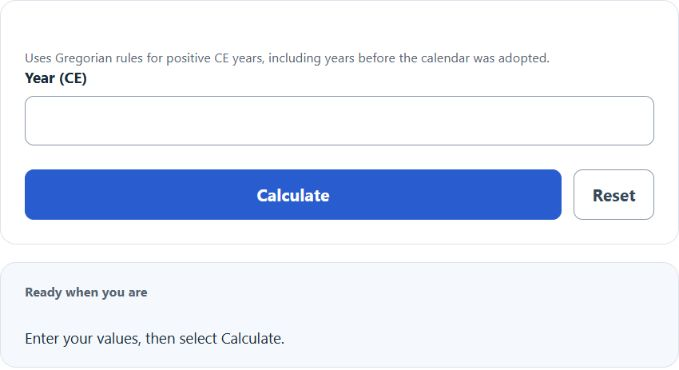
Calculate whether any entered year is a leap year using standard divisibility rules, with a clear Leap Year or Not a Leap Year result.
Related Calculators
- How Many Days Have I Been Alive? + Day of Week Born
- Anniversary Calculator
- 18 Months From Calculator
- Days In Advance Calculator
- All Everyday Life and Education Calculators
Leap Year Formula
The following Gregorian-calendar equation is used to determine if a positive CE year is a leap year. The calculator applies this rule even before the Gregorian calendar was historically adopted.
- Where Leap(Y) returns “Leap Year” if true and “Not a Leap Year” if false
- Y is the input year
- “mod” represents the modulus operation
To determine if a year is a leap year, apply the formula to the input year.
What is a Leap Year?
Definition:
A leap year is a year containing an extra day in February, resulting in 366 days, to keep the calendar synchronized with the Earth’s orbit around the Sun.
How to Calculate a Leap Year?
Example Problem:
The following example outlines the steps and information needed to determine if a year is a leap year.
First, consider the input year. In this example, the year is 2024.
Next, check if the year is divisible by 4. Since 2024 divided by 4 leaves no remainder, proceed to the next condition.
Then, because 2024 is not a century year, it meets all the criteria for a leap year.
Finally, by applying the formula above, we confirm that 2024 is a Leap Year.
FAQ
Why is it important to identify leap years?
Leap years help align the calendar with the Earth’s orbit around the Sun, ensuring seasonal consistency over time.
How often do leap years occur?
Leap years typically occur every four years, with the exception of century years which must be divisible by 400.
What should I do if the calculator shows an error?
If you receive an error, ensure you have entered a valid year. Enter a positive whole-number CE year. Fractions, zero, negative years and integers beyond JavaScript’s exact safe-integer range are not supported.