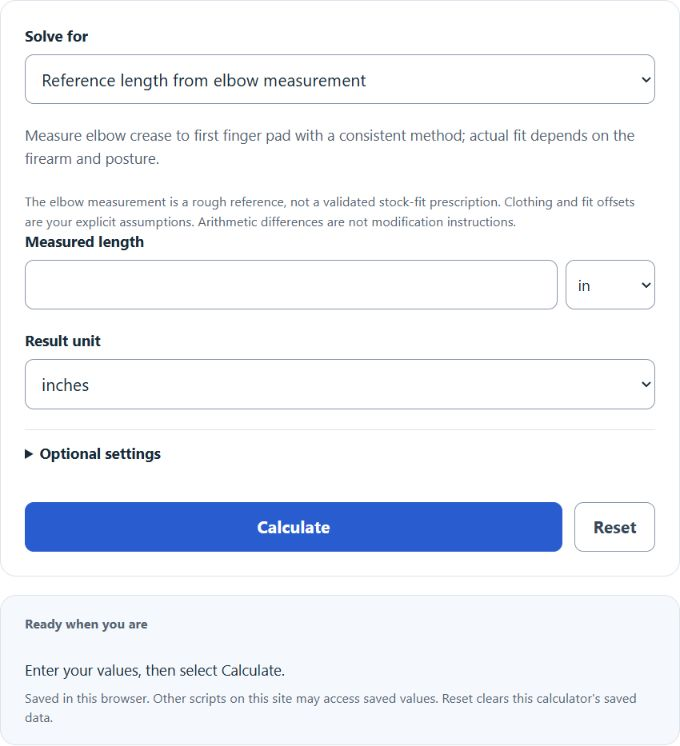
Calculate a starting length of pull for a shotgun or rifle from your elbow-to-trigger-finger measurement, compare it with a stock’s LOP, or convert units.
- All Sports and Fitness Calculators
- Draw Length Calculator
- APE Index (Wingspan To Height Ratio) Calculator
- Muzzle Energy Calculator
Length of Pull Formula
Reference mode adds your supplied elbow-crease-to-first-finger-pad measurement and two explicit signed offsets. This body measurement is only a rough starting reference, not a validated formula for an individual’s required stock length:
- LOPreference is the arithmetic reference length, expressed in the selected unit
- E is the elbow-to-finger measurement; C is your signed clothing allowance; F is your signed fit offset. Both optional offsets default to zero when blank.
Use consistent units before adding the values. Clothing allowance and fit offset are user-supplied assumptions; the calculator does not automatically subtract a fixed amount for medium or heavy clothing. Comparison mode reports target minus current length, with the sign showing which number is larger. Conversion mode uses 1 in = 2.54 cm = 25.4 mm. A nearest-one-eighth-inch value in Calculation details is numerical rounding only, not a modification dimension or fit recommendation.
What is a Length of Pull?
Definition:
For a firearm stock, length of pull is the distance from the trigger face to the center of the rear recoil pad or buttplate. Savage Arms defines it from the recoil-pad center to the trigger face; SIG Sauer also defines the trigger-to-stock measurement. It is distinct from bow draw length and from an elbow-to-finger body measurement. The result does not diagnose fit, assign a universal size category or provide stock-cutting or modification instructions.
How to Calculate Length of Pull?
Example Problem:
The following example illustrates reference arithmetic using a chosen offset; the offset is not a general clothing recommendation.
Suppose the supplied elbow-to-finger measurement is 14.25 inches, the user chooses a −0.25-inch clothing allowance, and the additional fit offset is zero.
Add the supplied values using the reference formula:
LOPreference = E + C + F
LOPreference = 14.25 + (−0.25) + 0
LOPreference = 14 inches = 35.56 cm = 355.6 mm. This is the result of the stated inputs, not a prescribed stock length or a validated fit assessment.