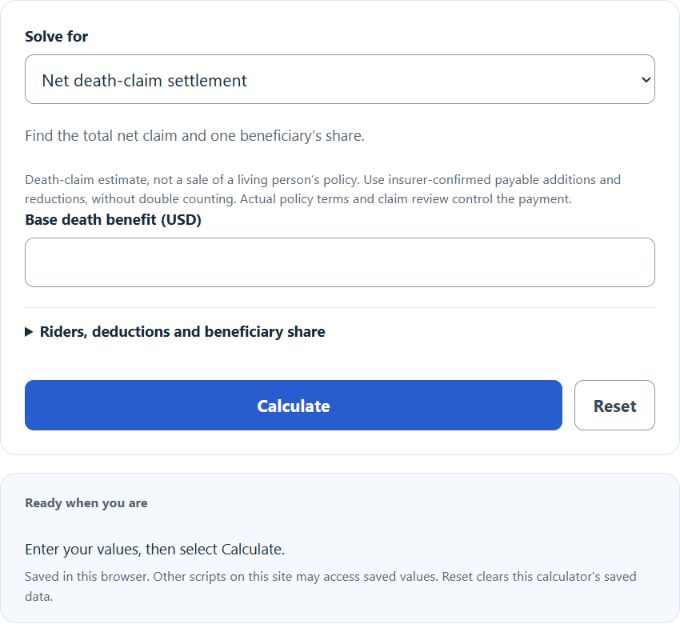
Life insurance settlement calculator to estimate a net death claim after payable riders, policy loans, interest, reductions for prior accelerated benefits, other deductions, and a beneficiary share. This is not a life-settlement sale valuation.
Life Insurance Settlement Formula
A simplified death-claim settlement adds payable rider benefits to the base death benefit and subtracts policy obligations and prior advances:
Net Settlement = max(0, Base Death Benefit + Rider Benefits - Policy Loans - Loan Interest - Accelerated Benefit Reduction - Other Deductions)
For a selected beneficiary share, the individual payment estimate is:
Beneficiary Payment = Net Settlement * Beneficiary Share (%) / 100
Variables:
- Base Death Benefit is the policy's stated death benefit before adjustments
- Rider Benefits are additional amounts assumed payable on the claim
- Policy Loans and Loan Interest are outstanding amounts secured by the policy
- Accelerated Benefit Reduction is the insurer-confirmed reduction in the remaining claim due to prior advances; it may differ from the cash paid. Do not subtract it twice if already reflected in the base benefit or another deduction.
- Other Deductions are claim-specific reductions entered by the user
- Beneficiary Share is the percentage assigned to the selected beneficiary
The reverse mode finds a nonnegative base benefit for an exact target. If payable riders already produce more than a positive target, no solution exists. A zero target may allow a range of base benefits fully offset by deductions. Blank additions and deductions mean zero; blank beneficiary share means 100%. Monetary inputs use cents, up to $1 trillion each; the beneficiary payment rounds half cents up.
Life Insurance Settlement Examples
These examples show how loans and prior benefits can reduce a payable death claim.
| Base benefit | Rider benefits | Loans and interest | Prior advances | Estimated net settlement |
|---|---|---|---|---|
| $250,000 | $0 | $0 | $0 | $250,000 |
| $500,000 | $25,000 | $16,200 | $0 | $508,800 |
| $500,000 | $0 | $50,000 | $100,000 | $350,000 |
| $1,000,000 | $100,000 | $75,000 | $0 | $1,025,000 |
Example Problems
Example 1: Estimate the net death claim.
A policy has a $500,000 base benefit and a $25,000 rider. A $15,000 loan and $1,200 of loan interest are outstanding.
The modeled net settlement is $500,000 + $25,000 − $15,000 − $1,200 = $508,800.
Example 2: Find the benefit needed for a target.
The desired net payout is $500,000, expected rider benefits are $25,000, and total deductions are $20,000.
The required base death benefit is $500,000 + $20,000 − $25,000 = $495,000.
Frequently Asked Questions
Do policy loans reduce a life insurance death benefit?
Outstanding loans and accrued interest generally reduce the amount payable unless they are repaid before death. A large loan can also contribute to policy lapse if values are insufficient.
Are life insurance death benefits taxable?
Death benefits paid to a beneficiary are often received income-tax-free, but exceptions can apply. Interest paid by the insurer, transfers for value, estate taxes, and business arrangements require separate review.
How are multiple beneficiaries paid?
The insurer applies valid beneficiary designations and any per-stirpes or contingent provisions. The share field estimates one beneficiary's percentage after the total modeled settlement is calculated.