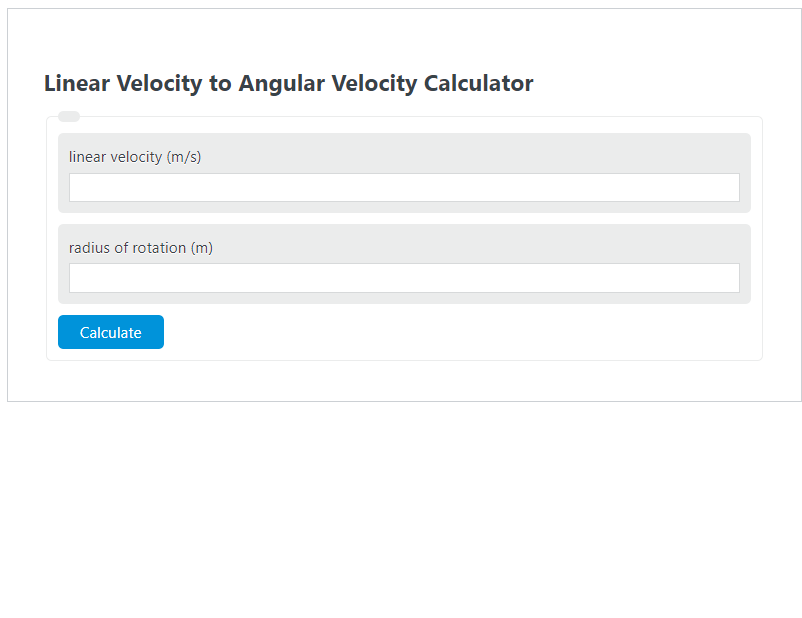
Calculate linear velocity, angular velocity, or radius of rotation from any two values, with units like m/s, mph, rad/s, rpm, meters, and feet.
- All Unit Converters
- Angular Velocity to Linear Velocity Calculator
- RPM to Angular Velocity Calculator
- Tangential Velocity Calculator
- Radians Per Second to Meters Per Second Calculator
- Angular Frequency Calculator
Linear Velocity to Angular Velocity Formula
Linear velocity measures how fast a point moves along a circular path, while angular velocity measures how fast the object rotates about its center. When the motion is circular and the radius stays constant, the conversion is direct:
Where:
- Angular velocity is the rotational speed, usually in radians per second.
- Linear velocity is the tangential speed along the edge of the circle, usually in meters per second.
- Radius is the distance from the center of rotation to the moving point.
| Quantity | Description | Typical Unit |
|---|---|---|
| Linear velocity | Speed along the circular path | m/s |
| Radius | Distance from center to the moving point | m |
| Angular velocity | Rate of rotation | rad/s |
| Time | Elapsed duration of motion | s |
| Angular displacement | Total angle swept out | rad |
Why the Formula Works
In circular motion, the arc length traveled is tied to the angle turned and the radius. The core relationship is:
If both sides are divided by time, arc length per second becomes linear velocity and angle per second becomes angular velocity:
Rearranging gives the calculator formula again:
This means:
- At a fixed radius, higher linear velocity produces higher angular velocity.
- At a fixed linear velocity, a larger radius produces lower angular velocity.
- Using diameter instead of radius will make the answer incorrect by a factor of 2.
Using the Calculator
- Enter the linear velocity.
- Enter the radius of rotation.
- The calculator returns the angular velocity in radians per second.
- If time is also known, the advanced version can determine the total angular displacement.
For angular displacement over time, use:
Combining the two relations gives:
Example
If the edge of a rotating wheel has a linear velocity of 50 m/s and the radius is 2 m, then the angular velocity is:
If that speed is maintained for 4 seconds, the total angular displacement is:
Unit Conversions and Helpful Relationships
The calculator is most accurate when units are consistent. If linear velocity is in meters per second, radius should be in meters. If your data uses other units, convert before calculating.
Additional rotation formulas that are often useful:
The formula above converts angular displacement in radians to revolutions.
The formula above converts radians per second to revolutions per minute.
The formula above converts revolutions per minute back to radians per second.
Common Mistakes
- Using diameter instead of radius: the equation requires radius, not the full width of the circle.
- Mixing units: for example, using km/h with meters can distort the result unless converted first.
- Entering a radius of zero: division by zero is undefined, so the calculation is not valid.
- Applying the formula to non-circular motion: the relationship assumes circular motion with a constant radius.
Where This Conversion Is Used
- Wheel and tire rotation
- Gears, pulleys, and belt systems
- Robotics and rotating arms
- Turbines, fans, and motors
- Physics and engineering problems involving tangential motion
Frequently Asked Questions
Is angular velocity the same as linear velocity?
No. Linear velocity describes motion along a path, while angular velocity describes rotational rate around a center. They are related, but they are not the same measurement.
Can angular velocity be negative?
Yes. A negative value usually indicates rotation in the opposite direction based on the sign convention being used.
What happens if the radius doubles?
If linear velocity stays the same and the radius doubles, angular velocity is cut in half.
Do radians have to be converted before using this formula?
No. Angular velocity is naturally expressed in radians per second, which is the standard unit used in most physics and engineering calculations.