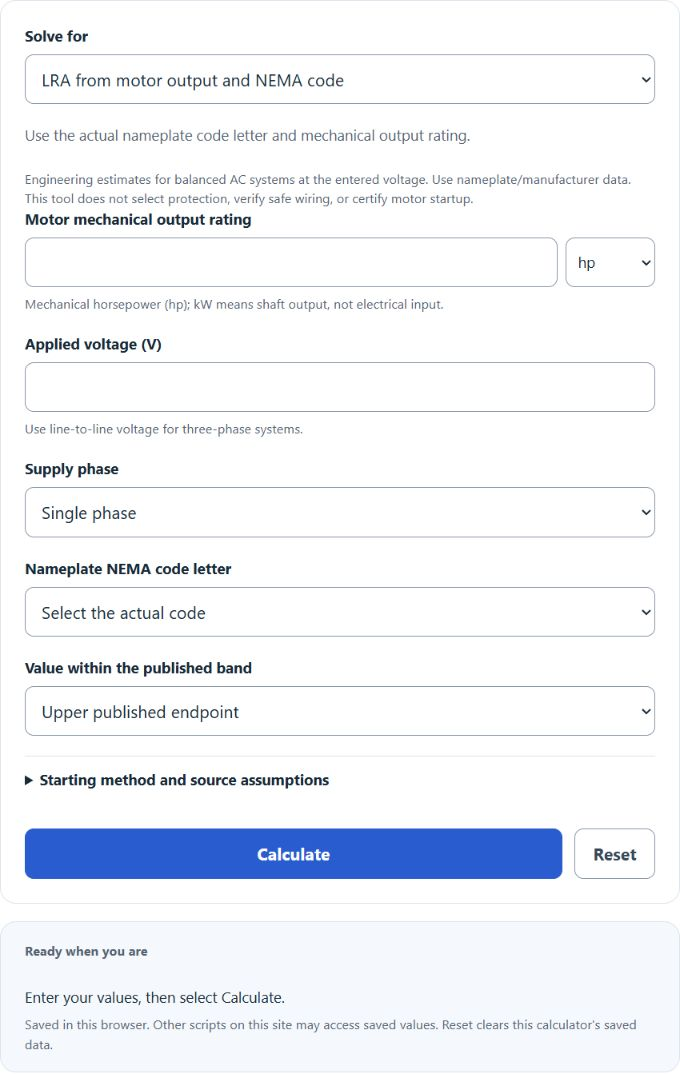
Calculate locked rotor amps and starting kVA from motor data, voltage and phase, or estimate full-load current using a supplied current ratio. Optional starter and source-impedance models are estimates, not startup certification or protection sizing.
Locked Rotor Amps Calculator Guide
Locked rotor amps (LRA) is the current a motor draws at standstill the instant rated voltage is applied. Because the rotor is not yet turning, the motor has not developed normal back electromotive force, so the current can be several times higher than the running current. This calculator helps you convert between locked-rotor starting kVA and locked rotor amps for both single-phase and three-phase systems.
Locked Rotor Amps Formula
Use the equation that matches the type of electrical system:
If you already know the starting current and want to solve for locked-rotor kVA, rearrange the formulas as follows:
- LRA = locked rotor amps in amperes
- kVA = locked-rotor or starting apparent power in kilovolt-amperes
- V = supply voltage for a single-phase system
- VLL = line-to-line voltage for a three-phase system
How to Use the Calculator
- Select the value to solve for, then choose single-phase or balanced three-phase.
- Enter the system voltage. For three-phase motors, use line-to-line voltage.
- Enter the values shown for the selected task. Direct conversion modes use known locked-rotor kVA or locked rotor amps; nameplate-code mode uses mechanical output and the actual code letter.
- Click calculate to solve for the missing value.
- Use volts, amperes and kVA as labeled. Motor-output kW is mechanical shaft power. Optional source estimates require supplied impedance data and cannot determine successful acceleration.
What the Result Means
The output represents the motor’s approximate current draw at startup under locked-rotor conditions. This is useful when evaluating motor starting behavior, estimating inrush impact on a feeder, comparing motor starting methods, or checking whether upstream equipment may see a significant short-duration current surge.
| Input | Meaning | Important Note |
|---|---|---|
| Voltage | The electrical supply applied to the motor | Use line-to-line voltage for three-phase systems |
| Locked-Rotor kVA | Apparent power during startup at standstill | This is not the normal running kVA |
| Locked Rotor Amps | Startup current at zero speed | Usually much higher than full-load current |
Example: Three-Phase Motor
Suppose a motor has a locked-rotor starting demand of 500 kVA on a 480 V three-phase supply. Substitute the values into the three-phase equation:
That means the motor can draw a startup line current of about 601 amps when the rotor is locked.
Example: Single-Phase Motor
If a single-phase motor has a locked-rotor starting value of 18 kVA on a 240 V supply, the startup current is:
This indicates a 75-amp locked-rotor current at startup.
Single-Phase vs. Three-Phase Calculations
The main difference is how voltage is applied in the equation. Single-phase current is based directly on the supply voltage, while three-phase current uses the line-to-line voltage together with the three-phase conversion factor. If the wrong voltage basis is used, the calculated current will be incorrect.
- Single-phase: enter the applied supply voltage directly.
- Three-phase: enter line-to-line voltage, and the result is line current.
- Do not mix line-to-line and phase voltage unless you intentionally convert between them first.
Common Mistakes
- Using full-load current values as if they were locked rotor amps.
- Entering running kVA instead of locked-rotor starting kVA.
- Using the wrong voltage reference for three-phase motors.
- Forgetting that startup current is a short-duration condition, not a continuous operating current.
- Ignoring unit conversions when switching between VA, kVA, MVA, A, and kA.
Why Locked-Rotor Amps Matters
LRA is one of the most useful numbers for understanding motor startup behavior. It can help when reviewing voltage drop concerns, estimating generator or transformer stress during motor starting, comparing across-the-line starts with reduced-voltage methods, and evaluating whether a system may experience nuisance tripping or noticeable inrush effects.
Frequently Asked Questions
Is locked-rotor amps the same as inrush current?
In most practical motor discussions, LRA is used as the motor’s startup or inrush current under locked-rotor test conditions. Actual field startup current can vary somewhat based on supply conditions and starting method.
Why is locked-rotor current so much higher than running current?
At standstill, the motor has not built normal back electromotive force, so the electrical system sees a much lower effective opposition to current. As the motor accelerates, current normally drops toward its operating level.
Can this calculator be used backward to find starting kVA?
Yes. If you know the locked-rotor amps and voltage, the calculator can solve for locked-rotor kVA using the inverse equations shown above.
Does the three-phase result represent line current?
Yes. When line-to-line voltage is entered for a three-phase system, the calculated locked-rotor amps value is the line current.
Can I use LRA alone to size breakers or overloads?
LRA is helpful for understanding starting current, but protective device selection also depends on motor type, starting method, duty cycle, conductor sizing, and the electrical rules being followed. It should be treated as one input, not the only design criterion.