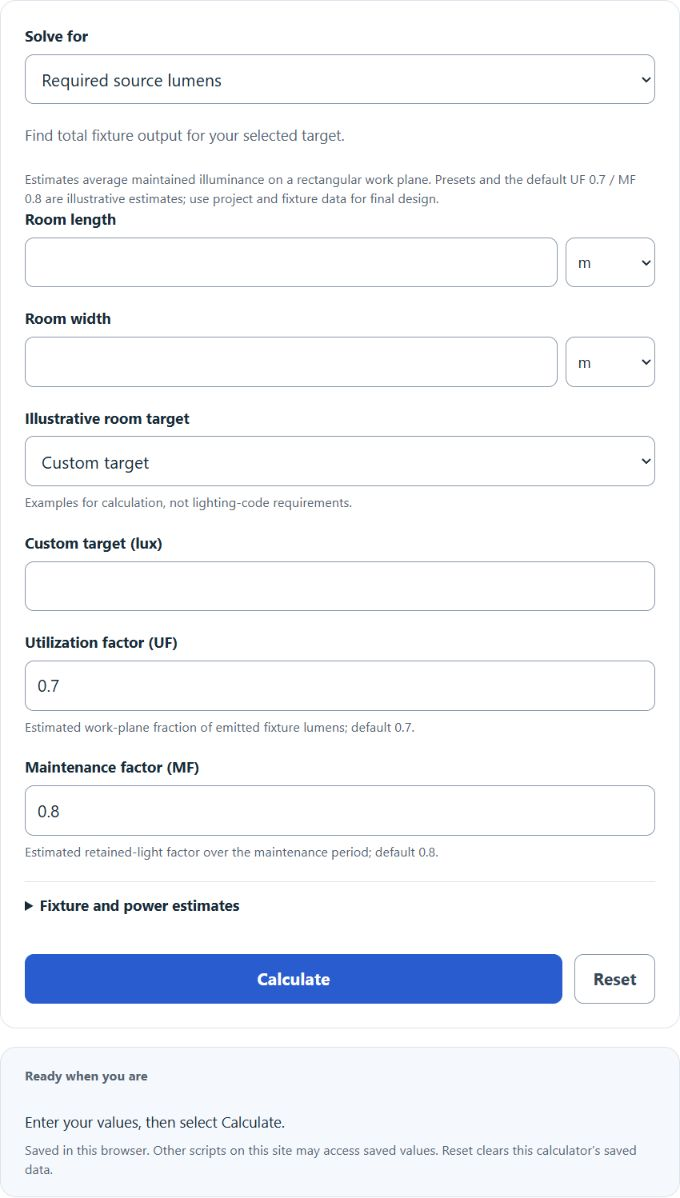
Estimate room lumens, LED fixture count, achieved lux, foot-candles, and connected watts with utilization and maintenance factors.
Lumens Per Room Formula
The lumen method estimates average maintained illuminance over a rectangular work plane and the total initial fixture output needed for a selected target. It does not predict the minimum at every point or prove lighting-code compliance.
Variables:
- Phi is the total initial emitted luminaire output required (lumens), before utilization and maintenance losses
- A is the work-plane area in square meters; convert each foot dimension using 1 ft = 0.3048 m before multiplying
- E is the selected average maintained illuminance in lux. UF is the fraction of emitted fixture lumens reaching the work plane; MF is the retained-light factor over the maintenance interval. Both must be above 0 and at most 1 in this model.
For N identical fixtures of F initial emitted lumens each, estimated average maintained illuminance is E = N * F * UF * MF / A. Required fixture count is ceil[E * A / (UF * MF * F)]. Round the count upward, then recompute achieved average illuminance. Use luminaire lumens and matching room utilance; bare-lamp coefficients may already include fixture efficiency. The editable defaults UF = 0.7 and MF = 0.8, and all room presets, are illustrative assumptions rather than measured values or code requirements.
What are Lumens?
Lumens measure the total amount of visible light emitted by a source. The higher the lumens, the brighter the light. When planning for lighting in a room, considering the lumens is important to ensure the space is well-lit according to its use. Different activities and room types require different levels of brightness, which is why lumens per square foot can vary.
How to Calculate Total Lumens Needed for a Room?
The following steps outline how to calculate the total lumens needed for a room.
- First, measure room length and width. Convert both dimensions to meters and multiply to find work-plane area A in square meters.
- Next, select a maintained average illuminance target E in lux and suitable utilization and maintenance factors from project data. The room presets are illustrative inputs only.
- Use Phi = E * A / (UF * MF) to estimate total initial emitted fixture lumens.
- If fixture lumens F are known, calculate N = ceil[Phi / F], and check the achieved average E = N * F * UF * MF / A. Optional fixture efficacy estimates input watts; rounded fixture counts determine connected watts.
- After inserting the variables and calculating the result, check your answer with the calculator above.
Example Problem :
Use the following variables as an example problem to test your knowledge.
Room area (A) = 150 square feet
For an illustrative target of 50 foot-candles, E = 50 / (0.3048 * 0.3048) ≈ 538.1955 lux. The 150 square foot area is 13.935456 square meters, so E * A = 7,500 lumens reaching the work plane. With UF = 0.7 and MF = 0.8, required initial fixture output is 7,500 / (0.7 * 0.8) ≈ 13,392.86 lumens. For 1,000-lumen fixtures, round 13.39286 up to 14 fixtures; their estimated maintained average is 562.59 lux (52.27 foot-candles). These are hypothetical example inputs, not a lighting recommendation.