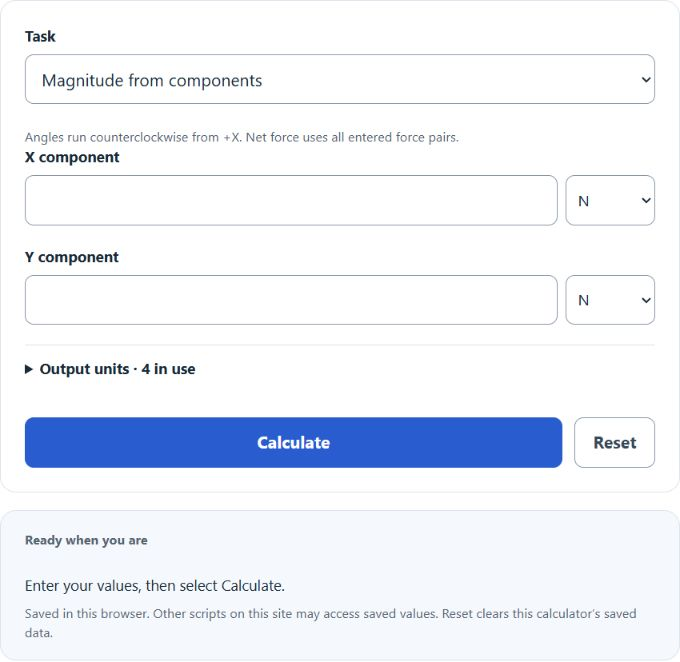
Calculate the magnitude of a force from its X and Y components, find the resultant of up to three forces, or use F = ma with mass and acceleration.
- All Physics Calculators
- All Force Calculators
- Applied Force Calculator
- Net Force Calculator
- Vertical & Horizontal Component Calculator
- Horizontal + Vertical Force Calculator
- Extension Force Calculator
Magnitude of Force Formula
The following equation is used to calculate the magnitude of a force.
- Where Fm is the magnitude of the force
- Fx is the x-component of the force vector
- Fy is the y-component of the force vector
To calculate force magnitude, add the squares of its x and y components, then take the square root. Choose a task explicitly; component and direction tasks use two known values.
What is a Magnitude of Force?
Definition:
In physics, a force is the push or pull that acts upon an object to make it move or accelerate. A force is said to have a magnitude (or strength) and direction.
The force can be expressed as a vector like a velocity, position, and acceleration. This vector has an x-component and a y-component, which both contribute to the overall magnitude of the force.
How to Calculate Magnitude of Force?
Example Problem:
The following example outlines the steps and information needed to calculate the Magnitude of Force.
First, determine the x-component of the force. In this example, the x-component of force is given as 50 N.
Next, determine the y-component of force. In this case, the y-component of force is given as 30 N.
Finally, calculate the magnitude of force using the formula above:
Fm = √(Fx2 + Fy2)
Fm = √(502 + 302)
Fm ≈ 58.3095 N