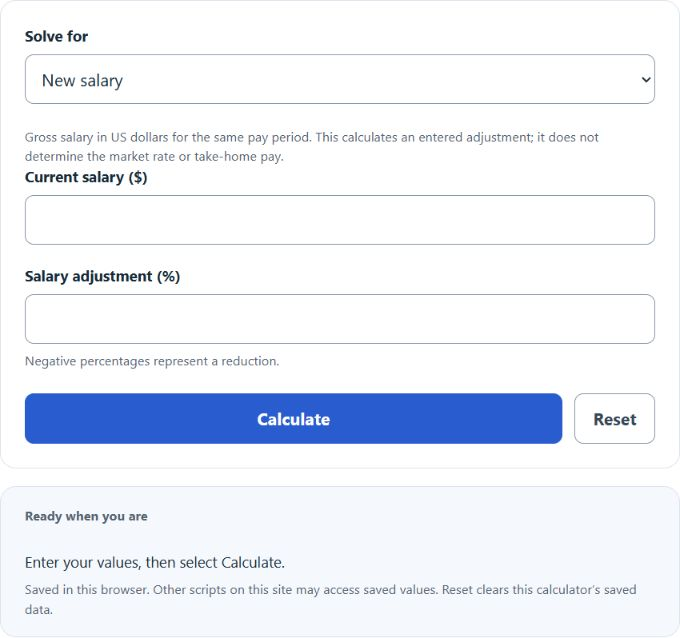
Choose new salary, current salary, or adjustment percentage, then enter the two requested values for the same pay period.
Market Adjustment Raise Formula
Variables:
- NS is the new salary ($)
- CS is the current salary ($)
- P is the market adjustment percentage (%)
A market adjustment raise is not based on performance. It realigns a salary to the current market rate for the role, title, and geography. The employer determines the adjustment using relevant market data and compensation policy; this calculator uses the percentage you enter.
Illustrative Market Adjustment Percentages
Compa-ratio is current salary divided by the market midpoint for the role. The ranges below are illustrative scenarios, not verified market benchmarks or recommended raises. Reaching the midpoint requires an increase of (1 / compa-ratio − 1) × 100%.
| Compa-Ratio | Position vs. Market | Illustrative Adjustment |
|---|---|---|
| < 80% | Significantly below market | 15–25%+ |
| 80–90% | Below market | 8–15% |
| 90–100% | Slightly below market | 3–8% |
| 100–110% | At or slightly above market | 0–3% |
| > 110% | Above market (green circle) | 0% (no adjustment) |
Market Adjustment vs. Other Raise Types
| Type | Based On | Illustrative Range (not a benchmark) | Trigger |
|---|---|---|---|
| Market Adjustment | External salary data | 3–20%+ | Pay compression, retention risk, compensation study |
| Merit Raise | Individual performance | 2–6% | Annual review cycle |
| COLA (Cost of Living) | CPI / inflation data | 2–3% | Annual, tied to inflation index |
| Promotion Raise | New role / responsibility | 8–15% | Role change, title change |
Salary Compression and Why Market Adjustments Happen
The most common trigger for a market adjustment is salary compression: when new hires are brought in at current market rates that exceed what long-tenured employees earn for the same role. Without periodic market adjustments, experienced employees can end up earning less than their newer colleagues. A compensation study, typically done annually using third-party salary surveys (Mercer, Radford, Willis Towers Watson), identifies which roles have drifted below market and by how much. The adjustment corrects the gap without requiring an employee to change roles or wait for a promotion.
Compounding Cost of Delayed Adjustments
Each year a salary goes unadjusted, the gap widens. An employee at $70,000 with a market rate of $80,000 is 12.5% below market. If the market rate grows 4% annually and the employee only receives a 2% COLA, the gap increases from $10,000 to $11,800 after one year. After three years the gap is approximately $16,922.96, making the eventual correction more disruptive. These assumed growth rates illustrate a widening gap; they do not establish the employer’s overall cost or an appropriate raise.
FAQs
What is a market adjustment raise?
A market adjustment raise is a salary increase made to bring an employee’s pay in line with current external market rates for their role, level, and location. It is not tied to performance. It corrects pay that has fallen behind the market due to inflation, increased demand for a skill set, or years without adequate salary increases.
How is a market adjustment different from a merit raise?
A merit raise rewards individual performance and is typically given during annual reviews. A market adjustment is triggered by external market data showing that the role pays more elsewhere, regardless of whether the employee is a strong or average performer. An employee can receive both in the same year.
What is a compa-ratio and how does it relate to market adjustments?
Compa-ratio is current salary divided by the market midpoint for the role, expressed as a percentage. A compa-ratio of 0.90 (90%) means the employee earns 10% below market. HR teams use compa-ratios to prioritize and size market adjustments: employees furthest below 100% receive the largest adjustments.
Do companies give market adjustments every year?
Not always. Employers choose their own schedule for compensation studies to benchmark roles against market data. Market adjustments are made when the study shows a significant gap, or off-cycle when a specific role is under retention pressure. High-demand roles in technology, healthcare, and data science are reviewed more frequently.
Is a market adjustment raise taxable?
Yes. A market adjustment is an increase to base salary and is subject to the same federal, state, and local income tax withholding as regular wages. It also affects FICA, Social Security, and Medicare contributions since it raises the annual wage base.