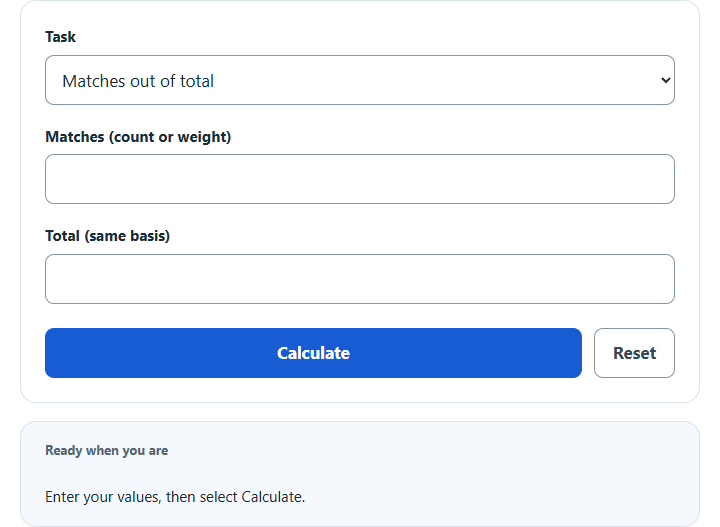
Calculate match percent from matches and total items or compare two lists to find overlap, matched items, unique items, and duplicates counted once.
Related Calculators
- Balance Percentage Calculator
- Rejection Percentage Calculator
- Fall Percentage Calculator
- Reverse Percentage Calculator
- All Math and Numbers Calculators
Calculator Functions
| Function | What it does | What it requires |
|---|---|---|
| Matches out of total | Finds the percent of a total that matched, with the number of mismatches and the reduced fraction | Requires the number of matches and the total, counted on the same basis |
| Compare two lists | Finds the percent of unique items that two lists share, and lists which items matched and which appear in only one list | Requires two lists of items. Optional: the item separator and whether letter case counts |
Compare two lists splits each list on commas, semicolons or new lines when it finds any, and on spaces otherwise. A separator can also be set by hand. Letter case is ignored unless Case sensitive is chosen, spaces around an item are trimmed, and each list can hold up to 2,000 unique items.
Match Percent Formulas
| P | Match percent (%) |
| M | Number of matches |
| T | Total number of items |
Matches out of total
The main formula applies directly: 50 matches out of 200 is 50 ÷ 200 × 100 = 25%. The result also shows 150 mismatches and the fraction 1/4. Weights can be used in place of counts as long as both numbers are on the same basis, and the matches cannot be more than the total.
Compare two lists
C is the number of items found in both lists, and U is the number of different items across the two lists together: the shared items plus those only in the first plus those only in the second. This ratio is the coefficient of community that Paul Jaccard used to compare the plant species of two districts [1], now usually called Jaccard similarity.
Comparing “red, green, blue” with “green, blue, yellow, black” gives 2 shared items out of 5 different ones, or 40%. An item repeated within a list counts once, and the order of the items does not matter.
Limits of This Estimate
- The list percent is measured against everything in both lists, so it is lower than the share of either list alone. In the example, 2 of the 3 items in the first list matched, which is 66.67% of that list but 40% overall. For the share of one list, use Matches out of total with the matched count and that list’s length.
- Items match only when the text is identical after trimming spaces and, by default, ignoring case. “Color” and “colour”, or “St.” and “Street”, count as different items.
- A match percent says how much overlaps, not how likely two things are to match in future.
Sources
- Jaccard, P. (1912), The Distribution of the Flora in the Alpine Zone, New Phytologist, vol. 11, no. 2, pp. 37-50: the ratio of items common to two sets to the total number of items in the two sets together