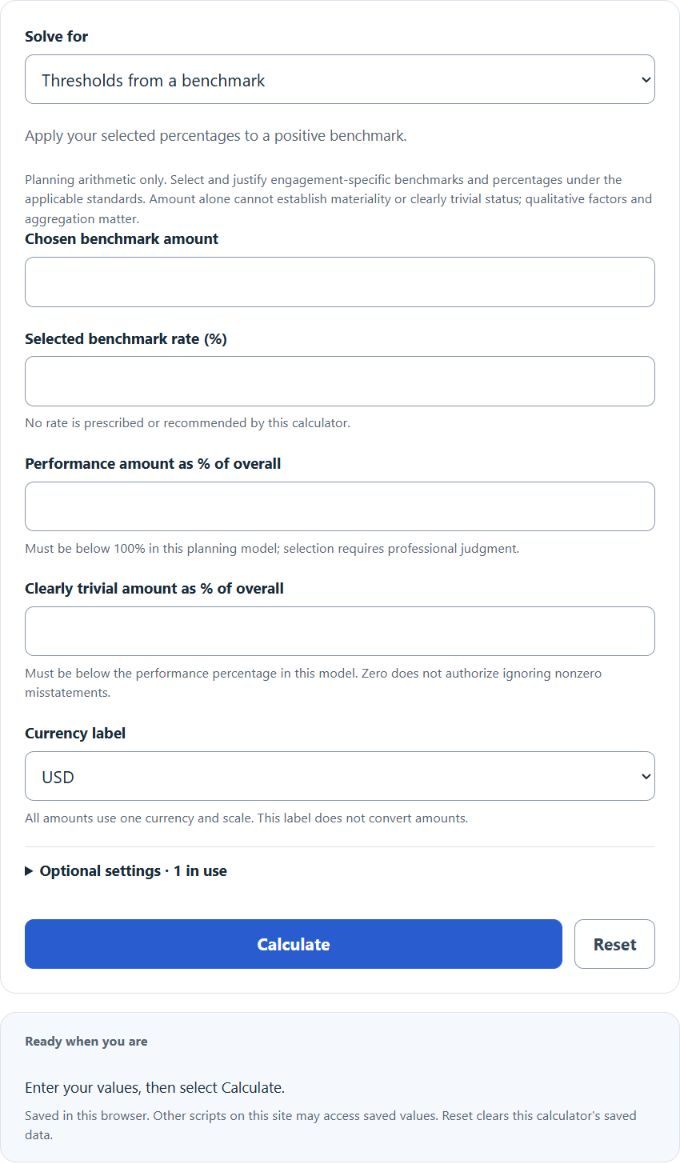
Calculate overall, performance, and clearly trivial audit thresholds from engagement-specific percentages, reverse-solve a benchmark, and compare sensitivity cases.
- All Business Calculators
- Return on Revenue Calculator
- Average Total Assets Calculator
- Profitability Ratio Calculator
- Expected Revenue Calculator
Materiality Formula
This calculator applies your engagement-selected percentage to a chosen benchmark. The arithmetic does not prescribe an appropriate benchmark, rate or audit conclusion; use one currency and scale throughout.
Variables:
- M is the overall materiality planning scenario (same currency and scale as the benchmark)
- B is the chosen positive benchmark amount
- r is the engagement-selected benchmark percentage
- Performance and clearly trivial scenario amounts use separately entered percentages of M
How to Calculate Materiality?
The following steps describe the calculator’s benchmark model. Professional judgment and applicable standards govern the inputs and their interpretation.
- First, select and justify a benchmark appropriate to the engagement.
- Next, select and justify the benchmark percentage; no percentage is supplied as a recommendation.
- Enter separately justified performance and clearly trivial percentages of overall materiality.
- Apply M = B × r / 100, or reverse it as B = M / (r / 100).
- Review any lower specific amount and the rate sensitivity scenarios.
- Evaluate qualitative factors, aggregation and possible undetected misstatements before drawing an audit conclusion. Clearly trivial is not another term for immaterial.
Example Problem:
Use the following variables as an example problem to test your knowledge.
Illustrative chosen benchmark (USD) = 50,000
Illustrative benchmark rate = 5%; performance percentage = 75%
Illustrative clearly trivial percentage = 5%; these are example assumptions, not recommended percentages
M = 50,000 × 5 / 100 = USD 2,500. Performance scenario = USD 1,875; clearly trivial amount = USD 125. These numerical amounts do not establish materiality or clearly trivial status by themselves.