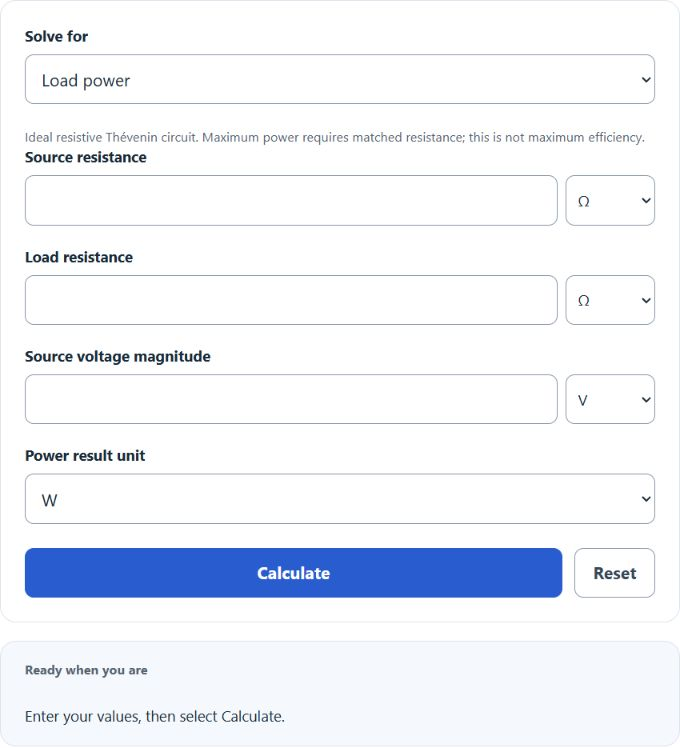
Select load power, load resistance, source resistance, voltage magnitude or maximum matched-load power for an ideal resistive circuit.
Related Calculators
- Resistor Drop Calculator
- Resistor Heat Calculator
- RMS Wattage Calculator
- AC ↔ DC Voltage Calculator
- All Physics Calculators
Maximum Power Transfer Formula
The calculator uses the load power equation for a voltage source with internal or source resistance in series with a load resistance.
- PL = power delivered to the load, in watts (W)
- VS = source voltage, in volts (V)
- RL = load resistance, in ohms (Ω)
- RS = source resistance, in ohms (Ω)
Maximum power transfer occurs when the load resistance equals the source resistance.
- Pmax = maximum possible power delivered to the load, in watts (W)
- RS = source resistance, in ohms (Ω)
- VS = source voltage, in volts (V)
Select the quantity to solve and enter its displayed known values. The missing value is found by rearranging the load power formula:
- Power delivered to load: uses the direct power formula with source voltage, source resistance, and load resistance.
- Source voltage: rearranges the power formula and takes the positive square root of the voltage magnitude.
- Load resistance: solves a quadratic equation because the load resistance appears in both the numerator and denominator.
- Source resistance: uses RS = |VS|√(RL/PL) − RL and requires a nonnegative result.
Common Unit Conversions for Resistance, Voltage, and Power
| Quantity | Unit | Base unit equivalent |
|---|---|---|
| Resistance | 1 kΩ | 1,000 Ω |
| Resistance | 1 MΩ | 1,000,000 Ω |
| Voltage | 1 mV | 0.001 V |
| Voltage | 1 kV | 1,000 V |
| Power | 1 mW | 0.001 W |
| Power | 1 kW | 1,000 W |
| Load condition | Meaning | Power transfer result |
|---|---|---|
| RL < RS | Load resistance is too low | Less than maximum |
| RL = RS | Matched resistance | Maximum power transfer |
| RL > RS | Load resistance is too high | Less than maximum |
Example Problems
Example 1: Calculate power delivered to the load
Suppose the source voltage is 12 V, the source resistance is 6 Ω, and the load resistance is 6 Ω.
The power delivered to the load is 6 W. Since the load resistance equals the source resistance, this is the maximum power transfer condition.
Example 2: Calculate source voltage
Suppose the load resistance is 10 Ω, the source resistance is 10 Ω, and the power delivered to the load is 2.5 W.
The source voltage is 10 V.
FAQ
What is the maximum power transfer condition?
Maximum power transfer occurs when the load resistance equals the source resistance. In symbols, RL = RS. At that point, the load receives the greatest possible power from the source for that source resistance and voltage.
Is maximum power transfer the same as maximum efficiency?
No. At maximum power transfer, the load resistance equals the source resistance, so the load and source resistance dissipate equal power. That means the efficiency is 50% in the ideal resistive case. Maximum power transfer is useful when getting the most load power matters more than minimizing losses.
Why can solving for resistance give more than one answer?
The power formula contains resistance in a squared denominator, so solving backward for a missing resistance creates a quadratic equation. With source voltage and source resistance fixed, a positive load power below the maximum corresponds to two positive load resistances: one below the matched resistance and one above it. The calculator reports both. Inverting source resistance with load resistance fixed instead gives at most one nonnegative solution. The maximum occurs at the single point where RL = RS.