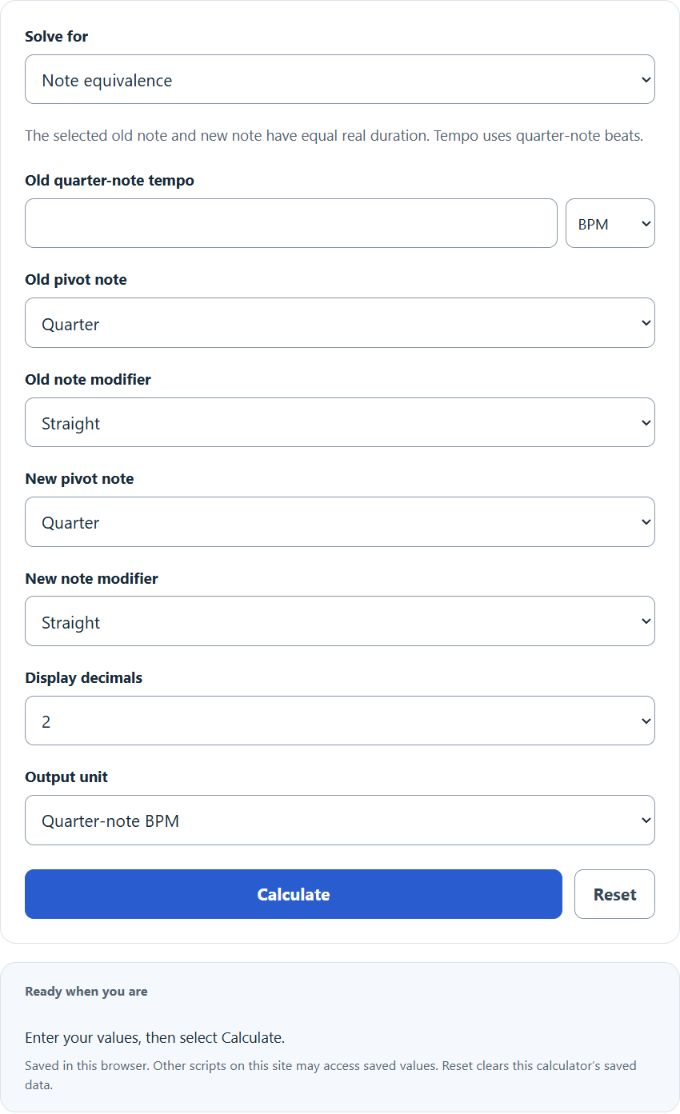
Calculate metric modulation tempo changes from note equivalence, subdivision ratios, or time-signature pivots between BPM and BPS.
Metric Modulation Formula
The following formula is used to calculate the Metric Modulation.
Variables:
- MM is the new bar rate (bars per minute)
- OT is the old bar rate (bars per minute)
- PNN is the number of pivot note values in the new measure
- PNO is the number of pivot note values in the old measure
With an equal-duration pivot pulse, new bar rate = old bar rate × old pivot count / new pivot count. For quarter-note BPM, new tempo = old tempo × new pivot-note fraction / old pivot-note fraction. A time-signature change alone does not change quarter-note BPM.
How to Calculate Metric Modulation?
The following steps outline how to calculate the Metric Modulation.
- First, determine the old bar rate. If using quarter-note BPM, divide it by the number of quarter notes in the old bar.
- Next, determine the number of pivot note values in the new measure.
- Next, determine the number of pivot note values in the old measure.
- Next, gather the formula from above = MM = OT * PNO / PNN.
- Finally, calculate the Metric Modulation.
- After inserting the variables and calculating the result, check your answer with the calculator above.
Example Problem:
Use the following variables as an example problem to test your knowledge.
old bar rate = 84 bars per minute; the pivot pulse stays constant
number of pivot note values in the new measure = 3
number of pivot note values in the old measure = 2
MM = 84 × 2 / 3 = 56 bars per minute. Quarter-note BPM also depends on the notated pivot values, so this bar-rate example is not a quarter-note tempo by itself.