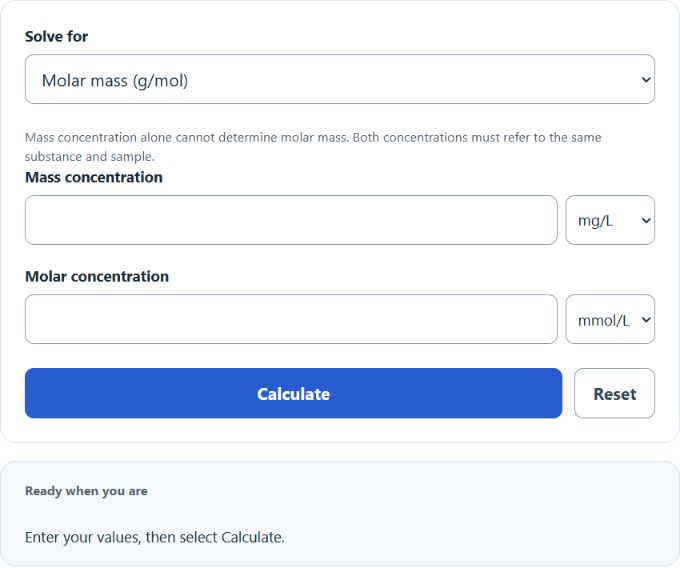
Determine molar mass in g/mol from mass concentration and molar concentration for the same substance, or convert between mg/L and mmol/L using a known molar mass.
- ug/l to ppt Converter
- uS/cm to ppm Converter
- ug/ml to ppb Converter
- mEq To mg Calculator
- All Unit Converters
mg/L to g/mol Formula
To determine molar mass, use M (g/mol) = mg/L ÷ mmol/L. The same relationship can be rearranged as follows to convert mg/L into mmol/L when molar mass is known.
Variables:
- mmol/L is the molar concentration
- mg/L is the mass concentration
- M is the molar mass in g/mol
The inverse form of the relationship is mg/L = (mmol/L) × M. Because 1 g = 1000 mg and 1 mol = 1000 mmol, the 1000 factors cancel, allowing you to divide the mg/L concentration directly by the molar mass in g/mol to obtain mmol/L.
What is the Relationship Between mg/L and g/mol?
mg/L is a mass-per-volume unit that describes how many milligrams of a substance are present in one liter of solution. g/mol is a molar mass unit that describes how much one mole of a substance weighs. Since these units measure different things, there is no direct standalone conversion between mg/L and g/mol. Instead, the molar mass in g/mol is used to convert mg/L into a molar concentration such as mmol/L.
For example, 100 mg/L of sodium chloride and 100 mg/L of glucose do not represent the same amount of substance because the compounds have different molar masses. A lower molar mass means more millimoles are present for the same mg/L value, while a higher molar mass means fewer millimoles are present.
How to Convert mg/L Using g/mol?
The following steps outline how to convert mg/L into mmol/L using the molar mass in g/mol.
- First, determine the concentration of the substance in mg/L.
- Next, determine the molar mass of the substance in g/mol.
- Finally, divide the mg/L value by the molar mass to calculate the concentration in mmol/L.
- After inserting the values and calculating the result, check your answer with the calculator above.
Example Problem:
Use the following variables as an example problem to test your knowledge.
Concentration = 100 mg/L
Substance = Sodium chloride (NaCl)
Molar Mass = 58.44 g/mol
mmol/L = 100 / 58.44 = 1.71 mmol/L
mg/L, g/mol, and mmol/L Conversion Table
The table below gives example conversions for a 100 mg/L solution of several common compounds using the relationship mmol/L = mg/L ÷ M (g/mol).
| Substance | Molar Mass (g/mol) | 100 mg/L in mmol/L |
|---|---|---|
| Sodium chloride (NaCl) | 58.44 | 1.71 mmol/L |
| Potassium chloride (KCl) | 74.55 | 1.34 mmol/L |
| Calcium carbonate (CaCO₃) | 100.09 | 1.00 mmol/L |
| Glucose (C₆H₁₂O₆) | 180.16 | 0.56 mmol/L |
| Urea (CH₄N₂O) | 60.06 | 1.67 mmol/L |
| Potassium permanganate (KMnO₄) | 158.04 | 0.63 mmol/L |
In laboratory work, results may be reported in mg/L, mmol/L, or in a way that references g/mol through the molar mass. Understanding how mg/L, g/mol, and mmol/L relate makes it easier to compare concentrations across different substances and references.