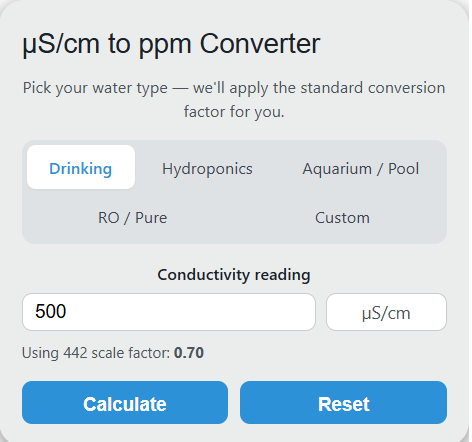
Convert µS/cm conductivity to ppm for drinking, hydroponic, aquarium, or RO water with preset factors and a custom conversion option.
- All Unit Converters
- mg/l to ppt Converter
- g/mol To ppm Calculator
- ppm To mol/L Calculator
- Grams To mEq Calculator
µS/cm to ppm Formula
The following formula is used to estimate total dissolved solids in parts per million from electrical conductivity measured in microsiemens per centimeter.
Variables:
- ppm is the estimated total dissolved solids in parts per million
- EC is the electrical conductivity in microsiemens per centimeter (µS/cm)
- f is the selected conversion factor, typically between 0.5 and 0.7
To calculate ppm from µS/cm, multiply the conductivity reading by the appropriate conversion factor for the water type, calibration scale, or meter setting being used.
What is µS/cm to ppm Conversion?
µS/cm to ppm conversion is a practical method used to estimate total dissolved solids from an electrical conductivity reading. Because dissolved minerals and salts conduct electricity, conductivity can be used as an indirect indicator of how much material is dissolved in water. However, the relationship is not exact, since different ions conduct differently. For that reason, ppm is usually estimated with an empirical conversion factor rather than a fixed universal ratio.
Many conductivity and TDS meters let users choose a factor such as 0.5, 0.64, or 0.7. A lower factor is common for NaCl-type calibration scales and low-mineral water, while a higher factor is often used for drinking water, natural freshwater, or hydroponic nutrient solutions. Knowing which factor your instrument uses helps you compare readings more accurately.
How to Convert µS/cm to ppm?
The following steps outline how to convert a conductivity reading in µS/cm to an estimated ppm value.
- First, determine the conductivity reading in microsiemens per centimeter (µS/cm).
- Next, select the appropriate conversion factor for the water type or meter scale.
- Then, multiply the conductivity reading by the factor using the formula ppm ≈ EC × f.
- Finally, compare the result with the calculator above to verify your answer.
µS/cm to ppm Conversion Table
The table below shows how a 1000 µS/cm conductivity reading converts to ppm using several common TDS factors.
| Water Type / Scale | Typical Factor | 1000 µS/cm in ppm |
|---|---|---|
| Very low mineral / RO water | 0.50 | 500 ppm |
| NaCl calibration solution | 0.55 | 550 ppm |
| Low mineral groundwater | 0.60 | 600 ppm |
| Typical freshwater | 0.64 | 640 ppm |
| Nutrient solution / hydroponics | 0.67 | 670 ppm |
| Drinking water / 442 scale | 0.70 | 700 ppm |
| High mineral / brackish water | 0.75 | 750 ppm |
Different meters may report different ppm values for the same conductivity reading if they use different conversion factors. That is why it is important to understand whether your meter is using a 0.5 scale, a 0.64 scale, a 0.7 scale, or another setting.
Example Problem:
Use the following variables as an example problem to test your knowledge.
Conductivity (EC) = 1500 µS/cm
Conversion Factor (f) = 0.64
Estimated ppm = 1500 × 0.64 = 960 ppm