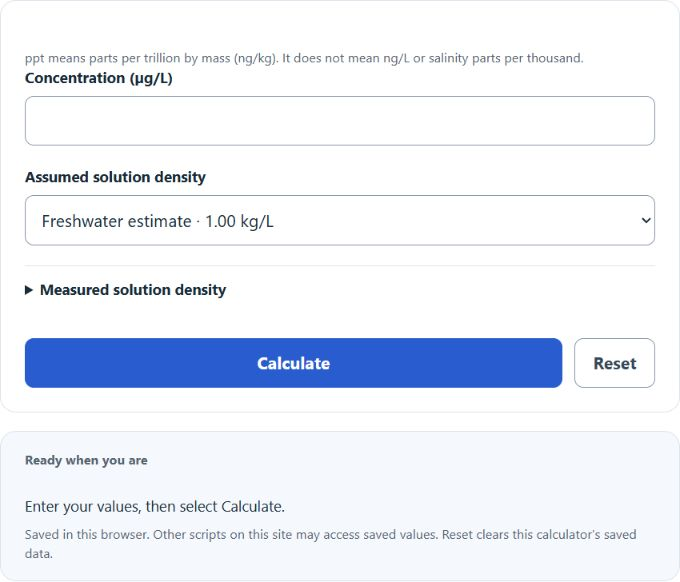
Convert µg/L to parts per trillion by mass (ng/kg), using an estimated or measured solution density.
- mEq/L To mg/dL Calculator
- g/ml to molarity Converter
- Grams To Percentage Calculator
- ng/mL To nmol/L Calculator
- All Unit Converters
µg/L to ppt Formula
The following formula converts micrograms per liter to parts per trillion by mass (ng/kg). It is exact for the supplied density; preset densities are estimates.
Variables:
- ppt is parts per trillion by mass, expressed as ng/kg of total solution
- µg/L is the concentration in micrograms per liter
- ρ is the density of the whole solution in kg/L or g/mL at its measurement conditions
For most natural waters, the density is close to 1.0, so the formula simplifies to ppt ≈ µg/L × 1000. This means a value of 1 µg/L is approximately equal to 1000 ppt.
What is µg/L to ppt Conversion?
µg/L to ppt conversion is used to express very small concentrations of dissolved substances in an equivalent mass-fraction format. Micrograms per liter describes how many micrograms of a substance are present in one liter of solution, while parts per trillion expresses how many parts of that substance exist per trillion parts of the total solution by mass. In dilute water-like samples, these units are closely related, which makes the conversion straightforward.
Confirm the reporting basis before comparing laboratory results or limits. Some water reports use ppt as shorthand for ng/L, which converts from µg/L by multiplying by 1,000 without density adjustment. Salinity ppt commonly means parts per thousand; this calculator uses neither convention.
How to Convert µg/L to ppt?
The following steps outline how to convert micrograms per liter into parts per trillion.
- First, determine the concentration in micrograms per liter (µg/L).
- Next, choose an estimated solution density, or enter a measured density under Measured solution density. A blank override uses the selected estimate.
- Then, apply the formula ppt ≈ (µg/L × 1000) ÷ ρ.
- If the density is close to 1.0, you can use the simplified conversion ppt ≈ µg/L × 1000.
- Finally, verify the result using the calculator above.
Example Problem:
Use the following values as an example problem to test your knowledge.
Concentration = 5 µg/L
Density = 1.0 g/mL
ppt = (5 × 1000) ÷ 1.0 = 5000 ppt
µg/L to ppt Conversion Table
The table below lists several representative concentrations in micrograms per liter and their approximate values in parts per trillion assuming a density of 1.0 g/mL.
| Concentration (µg/L) | Calculation | Value in ppt |
|---|---|---|
| 0.10 µg/L | 0.10 × 1000 | 100 ppt |
| 0.50 µg/L | 0.50 × 1000 | 500 ppt |
| 1.00 µg/L | 1.00 × 1000 | 1,000 ppt |
| 5.00 µg/L | 5.00 × 1000 | 5,000 ppt |
| 10.0 µg/L | 10.0 × 1000 | 10,000 ppt |
| 25.0 µg/L | 25.0 × 1000 | 25,000 ppt |
| 50.0 µg/L | 50.0 × 1000 | 50,000 ppt |
Compare concentrations only after confirming whether ppt denotes mass fraction, a water-reporting shorthand for ng/L, or parts per thousand. Density estimates vary with temperature and composition.