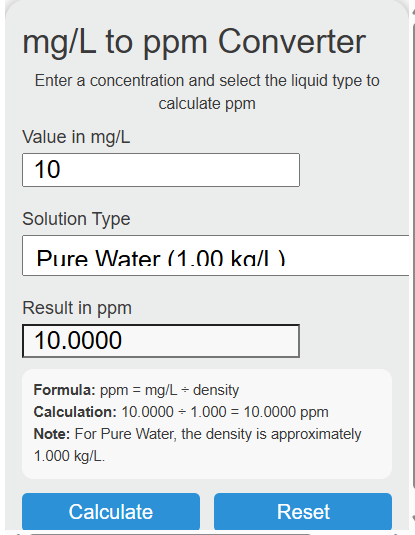
Convert mg/L to ppm for pure water, freshwater, seawater, or brine by entering concentration and choosing a solution type based on density.
Quick Overview: mg/L to ppm
mg/L measures mass per unit volume, while ppm is approximately mass per unit mass for water-like solutions. The relationship depends on the liquid density:
ppm = mg/L ÷ density (kg/L)
- Pure water (1.00 kg/L): 10 mg/L ≈ 10.00 ppm
- Freshwater (1.00 kg/L): 25 mg/L ≈ 25.00 ppm
- Seawater (1.025 kg/L): 10 mg/L ≈ 9.76 ppm
- Brine (1.20 kg/L): 10 mg/L ≈ 8.33 ppm
For dilute water-based solutions, mg/L and ppm are often nearly equal because the density is close to 1 kg/L. For denser liquids, the ppm value is slightly lower than the mg/L value.
- mg/l to lb/gal Converter
- mg/l to g/mol Converter
- ng/mg to ppm Converter
- Ppm To Mol/L Calculator
- All Unit Converters
mg/L to ppm Formula
The following formula is used to convert a concentration in milligrams per liter to parts per million.
Variables:
- ppm is the concentration in parts per million
- mg/L is the concentration in milligrams per liter
- ρ is the density of the solution in kilograms per liter
To calculate ppm from mg/L, divide the concentration in mg/L by the density of the liquid in kg/L. When the density is 1.00 kg/L, the mg/L and ppm values are numerically equal.
What is mg/L to ppm Conversion?
The mg/L to ppm conversion is used to express the same concentration in two closely related units. Milligrams per liter represents the mass of a substance dissolved in one liter of solution, while parts per million is typically interpreted as milligrams of substance per kilogram of solution for water-like mixtures. Because one liter of water has a mass of approximately one kilogram, mg/L and ppm are often treated as equivalent in freshwater applications.
However, when the liquid is denser than water, such as seawater or concentrated brine, one liter has a mass greater than one kilogram. In those cases, the ppm value becomes slightly smaller than the mg/L value for the same concentration. Using density in the formula provides a more precise conversion.
How to Calculate mg/L to ppm?
The following steps outline how to convert mg/L to ppm.
- First, determine the concentration in milligrams per liter (mg/L).
- Next, determine the density of the solution in kilograms per liter (kg/L).
- Then divide the mg/L value by the density using the formula ppm = mg/L / ρ.
- Finally, verify the result using the calculator above.
Example Problem:
Use the following variables as an example problem to test your knowledge.
Concentration (mg/L) = 10
Density (ρ) = 1.025 kg/L
ppm = 10 / 1.025 = 9.7561 ppm
Typical Density Reference Values
The following are common density values used when converting mg/L to ppm for water-based solutions.
- Pure water at room temperature: 1.00 kg/L
- Freshwater / drinking water: approximately 1.00 kg/L
- Seawater: approximately 1.025 kg/L
- Concentrated brine: approximately 1.20 kg/L
mg/L to ppm Conversion Table
The table below shows how 10 mg/L converts to ppm for several common liquid densities.
| Solution | Approx. Density (kg/L) | 10 mg/L in ppm |
|---|---|---|
| Pure Water | 1.00 | 10.00 ppm |
| Freshwater / Drinking Water | 1.00 | 10.00 ppm |
| Seawater | 1.025 | 9.76 ppm |
| Concentrated Brine | 1.20 | 8.33 ppm |
In many environmental, laboratory, and water-quality applications, assuming a density of 1 kg/L is accurate enough, which makes mg/L and ppm effectively interchangeable. For more precise work involving seawater, saline solutions, or other dense liquids, use the density-based formula to obtain the correct ppm value.