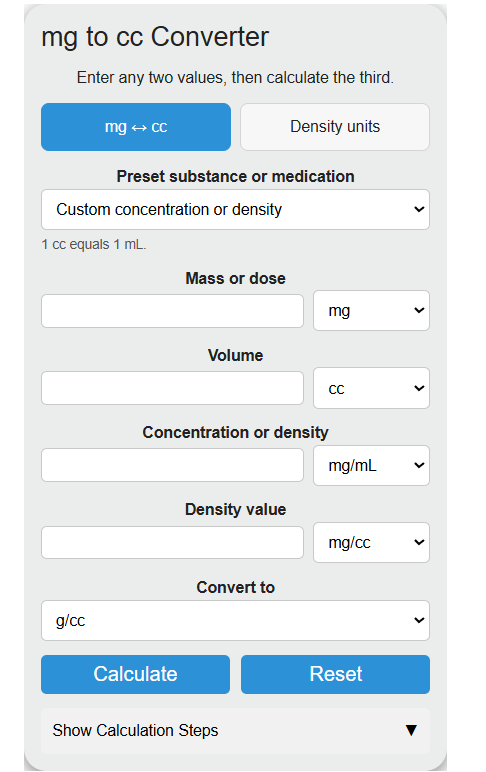
Convert milligrams to cubic centimeters or cc to milligrams using material density. Supports mg, g, cc, mL, density units, water estimates, and reverse calculations.
Quick overview: mg to cc
Milligrams (mg) measure mass, while cubic centimeters (cc) measure volume. To convert between them, you must know the density of the material.
- Water (~1000 mg/cc): 1000 mg ≈ 1.00 cc
- Ethanol (~789 mg/cc): 1000 mg ≈ 1.27 cc
- Olive oil (~915 mg/cc): 1000 mg ≈ 1.09 cc
- Glycerin (~1260 mg/cc): 1000 mg ≈ 0.79 cc
Lower-density liquids occupy more volume for the same mass, while higher-density materials occupy less volume.
- All Unit Converters
- ug/ml to ng/ul Converter
- ug/ml to molarity Converter
- ng/ml to pmol Converter
- Grams To Meq Calculator
mg to cc Formula
To convert from milligrams to cubic centimeters, divide the mass by the density of the substance expressed in mg/cc.
If the density is given in g/mL, remember that 1 mL = 1 cc and 1 g = 1000 mg, so you can also use the following form of the equation:
Variables:
- cc is the volume in cubic centimeters
- mg is the mass in milligrams
- density is the material density in mg/cc
For water, the density is about 1.00 g/mL, which is the same as 1000 mg/cc. That means 1000 mg of water ≈ 1 cc. Denser materials such as glycerin or honey will have a smaller volume for the same mass, while lighter liquids such as ethanol or acetone will have a larger volume.
What is mg to cc Conversion?
mg to cc conversion is the process of converting a unit of mass into a unit of volume by using density. Since milligrams measure how much matter is present and cubic centimeters measure how much space that matter occupies, the density provides the link between the two. This type of conversion is commonly used in chemistry, compounding, dosing, and formulation work.
How to Calculate mg to cc?
The following steps outline how to convert milligrams to cubic centimeters.
- First, determine the mass in milligrams (mg).
- Next, determine the density of the selected substance in mg/cc or convert it from g/mL.
- Then, divide the mass by the density using the formula cc = mg ÷ density.
- Finally, check your result with the calculator above.
Example Problem:
Convert 1000 mg of water into cubic centimeters.
Mass (mg) = 1000
Density of water = 1000 mg/cc
Volume (cc) = 1000 ÷ 1000 = 1.00 cc
mg to cc Conversion Table
The table below lists example conversions for a 1000 mg mass of several common liquids using typical reference densities.
| Substance | Approx. Density (g/mL) | 1000 mg in cc |
|---|---|---|
| Water | 1.00 | 1.00 cc |
| Ethanol | 0.789 | 1.27 cc |
| Olive oil | 0.915 | 1.09 cc |
| Glycerin | 1.26 | 0.79 cc |
| Propylene glycol | 1.04 | 0.96 cc |
| Acetone | 0.784 | 1.28 cc |
| Honey | 1.42 | 0.70 cc |
In real-world applications, density can vary slightly with temperature, concentration, and formulation. The values used in this converter are typical reference densities and are best used for quick estimates rather than laboratory-grade measurements.