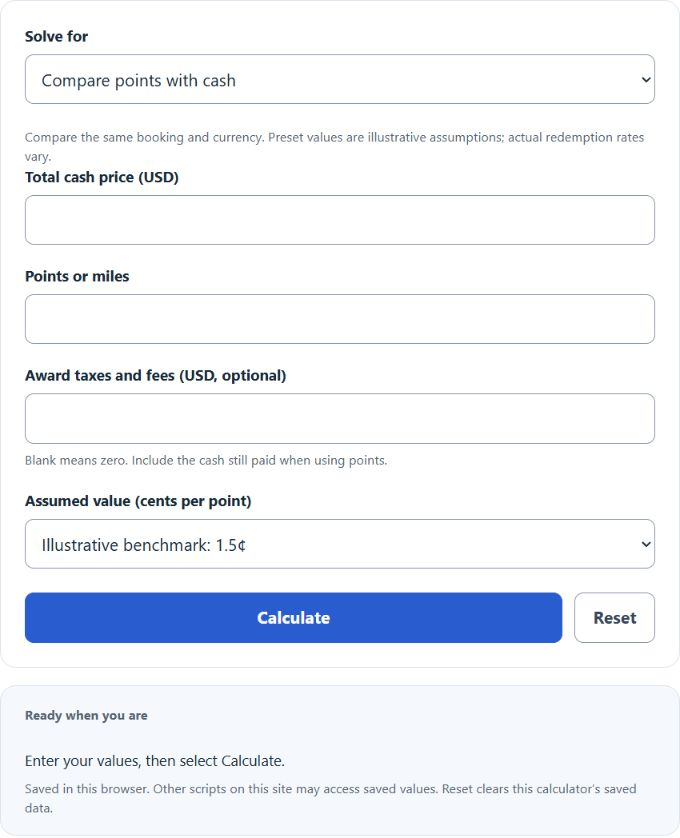
Calculate whether to use points or pay cash for any booking, find the cents-per-point value of an award, and get a clear recommendation.
Points or Cash Formula
CPP = (P - T) / N * 100
Points give more value if CPP > B; equal values are a tie; cash gives more value if CPP < B
Where:
CPP is the value of the redemption in cents per point. P is the cash price of the booking in dollars. T is the taxes and fees you still pay when booking with points. N is the number of points or miles the award requires. B is your benchmark value per point in cents.
The first formula tells you how much value each point returns on this specific booking. You subtract any taxes and fees from the cash price because those costs are not covered by your points, then divide by the points required and multiply by 100 to convert dollars to cents. The second line compares the redemption with your benchmark: above it favors points, below it favors cash, and equal values are a tie. Compare the same booking with all cash charges included; also consider rewards earned, availability and refund rules that this simple calculation excludes.
Value Benchmarks for a Redemption
Use your own value per point to judge a redemption. The following ranges are illustrative categories, not universal program rates or a substitute for your selected benchmark.
| Cents per point | Interpretation |
|---|---|
| Less than 1.0 | Poor value; pay cash and save the points |
| 1.0 to 1.5 | Average value; reasonable but not a standout |
| 1.5 to 2.0 | Good value; redeeming points is usually worth it |
| More than 2.0 | Excellent value; a strong reason to use points |
The table below preserves example benchmark assumptions for popular programs. These are not current issuer redemption quotes or guaranteed cash values; verify the actual booking and enter your own value when appropriate.
| Program | Illustrative assumption (cents per point) |
|---|---|
| American AAdvantage | 1.4 |
| Delta SkyMiles | 1.2 |
| United MileagePlus | 1.3 |
| Chase Ultimate Rewards | 2.0 |
| Amex Membership Rewards | 2.0 |
| Capital One Miles | 1.7 |
Example Problems
Example 1. A flight costs $450 in cash or 35,000 miles plus $11.20 in taxes and fees. Your benchmark value is 1.5 cents per point. The net cash cost is $450 minus $11.20, which is $438.80. The value per point is $438.80 divided by 35,000, multiplied by 100, which is 1.25 cents per point. Because 1.25 is below your 1.5-cent benchmark, you are better off paying cash and saving the miles.
Example 2. A hotel night costs $300 in cash or 20,000 points with no extra fees. Using the same 1.5-cent benchmark, the value per point is $300 divided by 20,000, multiplied by 100, which is 1.5 cents per point. This matches your benchmark, so redeeming points is a fair deal, especially if you would rather keep the cash.
FAQ
Should I always use points when the value per point is high? A high value per point means the redemption is efficient, but you should still confirm you are not saving those points for an even better trip. If the value clears your benchmark and you have no higher-value plan for the points, redeeming is usually the right move.
Why do I subtract taxes and fees from the cash price? When you book with points you often still pay taxes and fees in cash. Those costs are not covered by your points, so subtracting them gives you the true cash amount your points are replacing and a more accurate value per point.
What benchmark value should I use? Use the value you expect from your available redemption choices. The 1.5-cent default and program presets are illustrative assumptions, not universal or current issuer rates. Select Custom value to use your own benchmark.