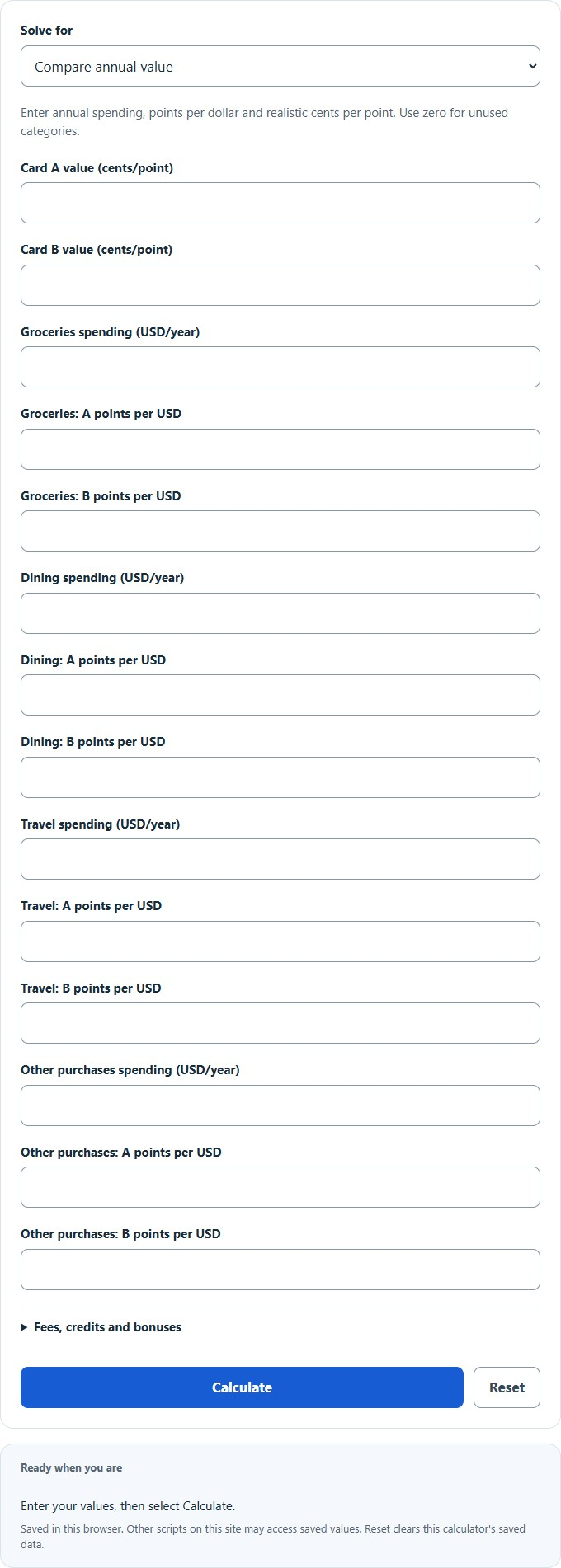
Compare estimated annual rewards value in USD by spending category, point value, fees, usable credits and eligible bonuses, or calculate a constant-rate spending break-even point. Interest, other costs, reward caps and eligibility rules are not included; use your actual card terms and redemption estimates.
Rewards Card Comparison Formula
The annual reward value for each card is the sum of category spending multiplied by the card’s earning rate and the value of each point:
Reward Value = Σ(Spend_i * Points per Dollar_i * CPP / 100)
Net annual value adds usable credits and bonuses, then subtracts the annual fee:
Net Annual Value = Reward Value + Credits + Bonus Value - Annual Fee
For a flat-rate break-even comparison, the annual spending where two cards have equal modeled value is:
Break-Even Spend = (Fixed Value_B - Fixed Value_A) / (Rate_A - Rate_B)
Use the reward rates as decimals in the break-even formula. For example, 3% is 0.03.
Variables:
- Spend_i is annual spending in category i, such as groceries, dining, travel, or other purchases
- Points per Dollar_i is the card’s earning multiplier in that category
- CPP is the realistic redemption value in cents per point
- Credits are only the statement credits or perks you expect to use without changing your behavior
- Fixed Value is credits plus bonus value minus annual fee
The same rewards currency can have different values depending on how it is redeemed. Enter a conservative point value based on the redemption method you regularly use. For a cash-back card, enter the cash-back percentage as the effective rate in break-even mode or use one point per dollar with a point value that produces the correct percentage.
Reward Multiplier to Effective Return
Multiply points earned per dollar by cents per point to obtain the percentage return. For example, 3 × 1.5 = 4.5%. Divide by 100 only when converting that percentage to a decimal return (0.045).
| Earning rate | At 1.0¢ per point | At 1.25¢ per point | At 1.5¢ per point |
|---|---|---|---|
| 1 point per $1 | 1.00% | 1.25% | 1.50% |
| 2 points per $1 | 2.00% | 2.50% | 3.00% |
| 3 points per $1 | 3.00% | 3.75% | 4.50% |
| 4 points per $1 | 4.00% | 5.00% | 6.00% |
| 5 points per $1 | 5.00% | 6.25% | 7.50% |
Example Problems
Example 1: Compare category rewards.
You spend $6,000 on groceries. Card A earns 3 points per dollar worth 1.2 cents each, so its grocery reward value is $6,000 * 3 * 1.2 / 100 = $216. Card B earns 2 points per dollar worth 1 cent each, so its value is $120. Repeat this calculation for the other categories, add the results, then include fees and usable credits.
Example 2: Find a flat-rate break-even point.
Card A earns 3% but has a fixed annual value of -$95 after its fee. Card B earns 2% and has a fixed value of $0. The break-even spend is ($0 – -$95) / (0.03 – 0.02) = $9,500 per year. Above that spending level, Card A’s extra 1% offsets its fee.
Frequently Asked Questions
Should I include a welcome bonus?
Include it for a first-year comparison only when you are confident you will meet the requirement without extra spending. Set bonus values to zero when comparing long-term ongoing value because a one-time bonus can hide a weak recurring return.
How should I value statement credits?
Count a credit at full value only when it replaces spending you already planned. A $100 credit for a service you would not otherwise buy is not worth $100 to you. Use the amount of real cash spending it will replace.
What if points have multiple redemption values?
Use the value from your likely redemption, not the highest advertised possibility. Running the comparison at a conservative and an optimistic cents-per-point value can show whether the decision changes under different assumptions.