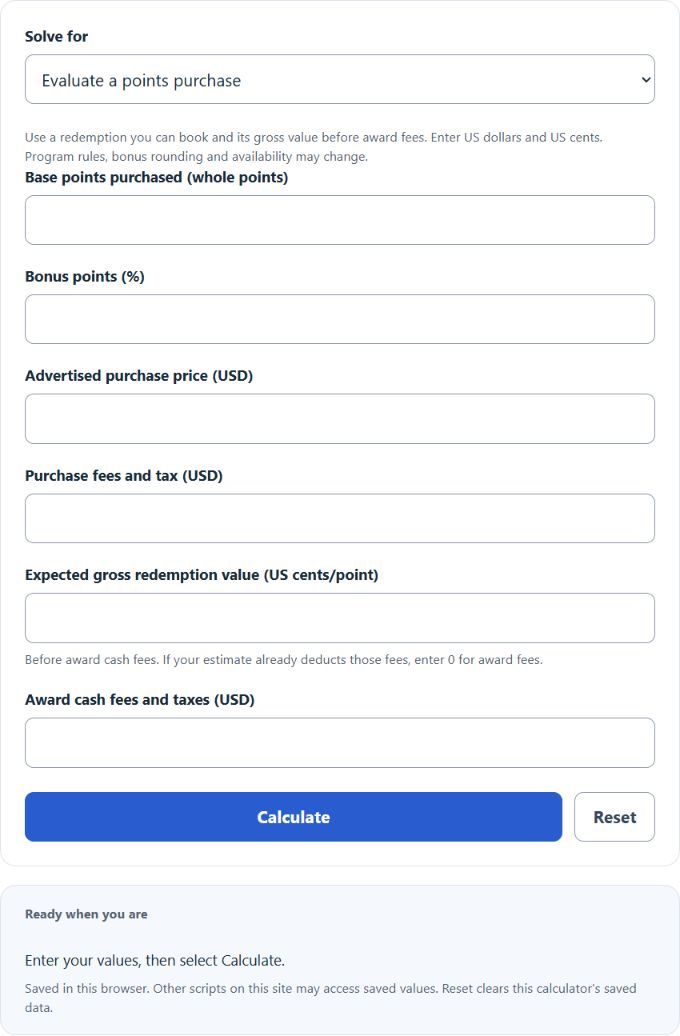
Use the Points Purchase Calculator to model cost per point, redemption value, value surplus, and a purchase-price ceiling from your assumptions. Use a redemption you can actually book, a common US-dollar currency basis, and gross value before award cash fees. The result is not a safe-price guarantee.
Points Purchase Formula
When a program sells points with a bonus, first calculate the total points received:
Total Points = Base Points * (1 + Bonus % / 100)
The all-in acquisition cost per point is:
Cost per Point (cents) = (Purchase Price + Fees) / Total Points * 100
Estimated redemption value and modeled surplus are:
Redemption Value = Total Points * Target CPP / 100
 Value Surplus = Redemption Value - Award Fees - Acquisition Cost
To model an acquisition budget using your chosen value margin:
Maximum All-In Cost = (Redemption Value - Award Fees) * (1 - Margin % / 100)
Maximum Advertised Price = Maximum All-In Cost - Purchase Fees
A negative net redemption value or a negative advertised-price ceiling means no nonnegative purchase price fits the model. A zero ceiling is feasible only when the fees fit the budget. For prices payable in whole cents, round a nonnegative ceiling downward. Enter award fees once: if your cents-per-point estimate already deducts them, enter zero award fees.
Variables:
- Bonus % is the extra points added to the base purchase
- CPP is the expected redemption value in cents per point
- Fees include purchase tax, processing charges, or other acquisition costs
- Award Fees are cash charges paid when redeeming the points
- Margin is the value cushion required between expected value and acquisition cost
A points purchase can look attractive at a low acquisition cost but still be poor value when award availability is limited, taxes are high, or the program changes its pricing. Use a redemption you can realistically book and include every cash fee.
Cost of Buying Points
The table uses a hypothetical gross redemption value of 1.5 US cents per point, before award cash fees. This assumption gives $150 for 10,000 points and $750 for 50,000 points; it is not a quoted program value.
| Acquisition cost | Cost for 10,000 points | Cost for 50,000 points | Value at 1.5¢ each |
|---|---|---|---|
| 0.75¢ per point | $75 | $375 | $150 / $750 |
| 1.00¢ per point | $100 | $500 | $150 / $750 |
| 1.25¢ per point | $125 | $625 | $150 / $750 |
| 1.50¢ per point | $150 | $750 | $150 / $750 |
| 2.00¢ per point | $200 | $1,000 | $150 / $750 |
Example Problems
Example 1: Evaluate a bonus sale.
You buy 50,000 points with a 25% bonus for $750 and no purchase fee. You receive 62,500 points. The acquisition cost is $750 / 62,500 * 100 = 1.20 cents per point. At an expected value of 1.5 cents each, the points are worth $937.50 before award fees, creating a modeled value surplus of $187.50.
Example 2: Set a maximum price.
You assume 60,000 points provide 1.4 US cents each of gross redemption value, or $840. Award fees of $40 leave $800 of net value. A chosen 20% margin gives a modeled acquisition budget of $800 * 80% = $640. After $15 in purchase fees, the modeled advertised-price ceiling is $625. This arithmetic does not establish availability or guarantee value.
Frequently Asked Questions
Is it worth buying points?
Buying points can make sense for a specific near-term redemption when the all-in acquisition cost is clearly below the value you will receive. It is usually riskier to buy points speculatively because programs can devalue points or restrict award availability.
Should bonus points be included in cost per point?
Yes. Divide the entire cash cost by all points received, including the promotional bonus. Excluding the bonus would overstate the acquisition cost and misrepresent the offer.
What does the value margin mean?
A chosen margin reduces the spending budget below your estimated net redemption value. It does not guarantee award availability, refunds, stable point value, or protection from program changes. Confirm the current program terms and the full cash cost of the redemption before buying; purchased points may be nonrefundable.