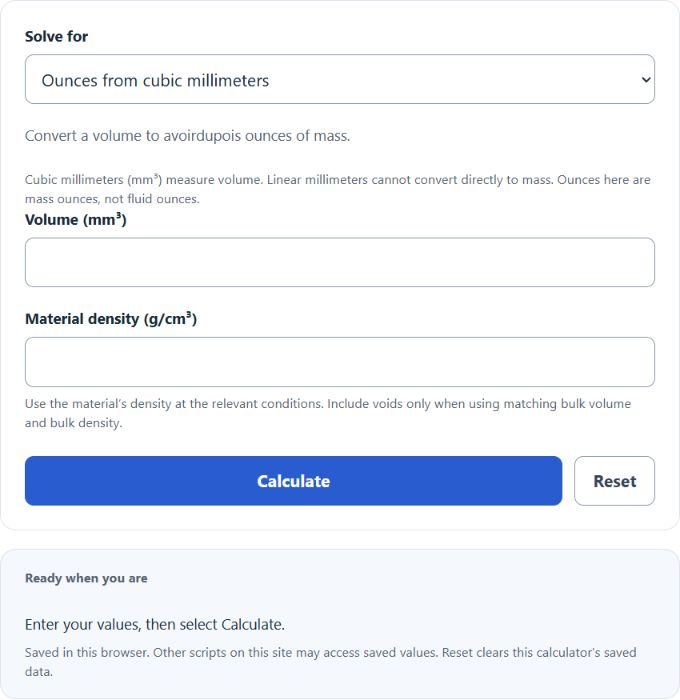
Convert a material volume in cubic millimeters to mass in ounces using density. A linear millimeter cannot be converted directly to ounces, so this calculator interprets “mm to oz” as mm³ to mass.
Enter the material’s density for the same volume basis and relevant conditions. The calculator starts with empty measurements rather than an assumed material density.
How to Use This Calculator
- Choose whether to solve for ounces or cubic millimeters.
- Enter the known volume or mass.
- Enter density in g/cm³ from a reliable source.
- Calculate and confirm that the source measurement is volume, not length.
After a successful calculation, the inputs and result remain saved in this browser. Select Reset to clear the stored values and restore the calculator defaults.
How the Cubic Millimeters to Ounces Calculator Works
The ounce shown is an avoirdupois mass ounce, not a fluid ounce. Volume is first converted from mm³ to cm³, multiplied by density to obtain grams, and then converted to ounces.
The primary relationship is ounces = (mm³ ÷ 1,000 × density) ÷ 28.349523125; reverse the steps for mm³. Calculations retain full available precision internally; displayed values are rounded for readability.
Formula Variables and Input Guide
Choose whether to find mass or volume, enter the known cubic-millimeter or ounce amount, and supply density in grams per cubic centimeter.
| Variable or term | Meaning | Unit or note |
|---|---|---|
| V | Volume | mm³ |
| ρ | Material density | g/cm³ |
| m | Mass | g or oz |
| 1 cm³ | 1,000 mm³ | exact volume relation |
Choosing the Right Inputs
Confirm that the volume is in cubic millimetres, written mm³, rather than a one-dimensional length in millimetres. A length alone cannot determine mass without the other dimensions. Select the direction that matches the known value: volume to mass ounces or mass ounces back to the volume occupied at the stated density.
Enter density in grams per cubic centimetre for the exact material and relevant temperature. Do not substitute a bulk density for a solid density unless void space is intentionally included. The ounce output is an avoirdupois unit of mass, not a US fluid ounce; a fluid-ounce measurement would require a separate volume conversion rather than material density.
Practical Uses
- Estimating mass from a modeled part volume.
- Comparing materials at the same component volume.
- Converting CAD volume output into approximate part weight.
- Checking whether an mm measurement is actually cubic volume.
Mass of 1,000 mm³ by density
| Density | Mass |
|---|---|
| 1.00 g/cm³ | 0.035274 oz |
| 2.70 g/cm³ | 0.095240 oz |
| 7.85 g/cm³ | 0.276901 oz |
Understanding Your Results
The selected mode returns mass in ounces and grams or volume in cubic millimeters and cubic centimeters.
The result scales directly with both volume and density. A 5% density error produces roughly a 5% mass error when volume is unchanged.
Worked Example
1,000 mm³ is 1 cm³. At 1 g/cm³, it weighs 1 g, or about 0.035274 oz.
For aluminum at approximately 2.70 g/cm³, 5,000 mm³ is 5 cm³. Its estimated mass is 13.5 g, or about 0.4762 oz.
Checking the Result by Hand
Divide mm³ by 1,000 to obtain cm³, multiply by density in g/cm³ to obtain grams, and divide grams by 28.349523125 for avoirdupois ounces. In reverse, multiply ounces by 28.349523125 and divide by density before converting cm³ back to mm³.
The units should cancel cleanly at every step. At 1 g/cm³, 1,000 mm³ must equal 1 g or about 0.035274 oz; doubling either volume or density should double mass.
Common Mistakes to Avoid
- Entering a one-dimensional length instead of volume.
- Confusing mass ounces with fluid ounces.
- Using kg/m³ without converting to g/cm³.
- Ignoring voids, porosity, temperature, or mixture composition.
Assumptions and Limitations
Density varies with material, temperature, pressure, and composition. If you only know a length in millimeters, you also need cross-sectional dimensions and density.
Frequently Asked Questions
Can plain mm convert to oz?
No. You need volume or enough dimensions to calculate volume, plus density.
Is the output fluid ounces?
No. It is avoirdupois ounces of mass.
Where do I find density?
Use a manufacturer datasheet, safety data sheet, or authoritative material reference.
Why does temperature matter?
Many materials expand or change density as temperature changes.
Sources