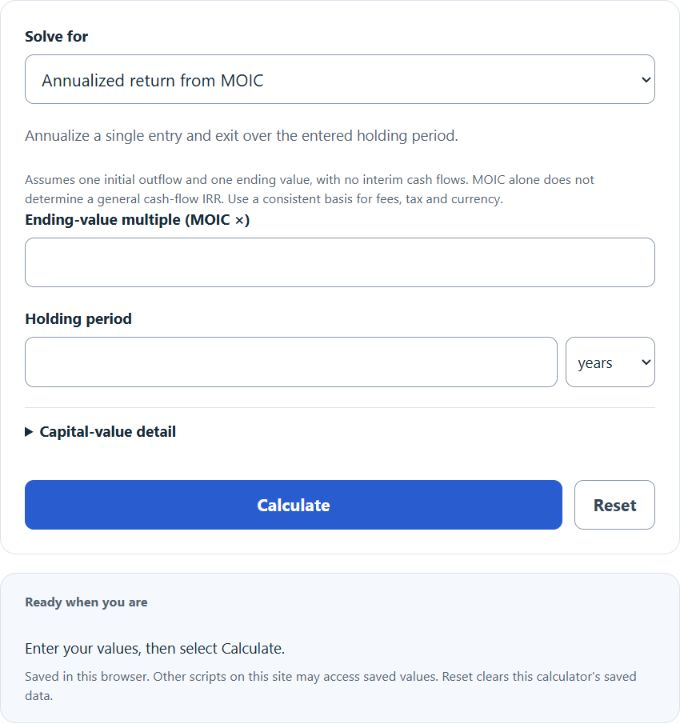
Convert MOIC to annualized IRR, reverse-calculate MOIC or holding period, and compare the same multiple across 3-, 5-, and 7-year holds.
Related Calculators
- Money Multiplier Calculator
- ESOP Calculator
- Sales Multiplier Calculator
- Income Statement Calculator
- All Business Calculators
MOIC To IRR Formula
For one initial outflow and one ending value, with no interim cash flows, the following compounding formula converts MOIC (Multiple on Invested Capital) to an equivalent annualized return. General IRR requires the cash-flow amounts and timing.
Variables:
- IRR is the Internal Rate of Return (%)
- MOIC is the Multiple on Invested Capital (no units)
- n is the investment duration in years
Raise MOIC to the reciprocal of the duration in years, subtract 1, then multiply by 100 to display the annual return as a percentage. Reverse modes solve MOIC or a unique positive duration. Years and months convert at 12 months per year; optional invested capital illustrates ending value and gain in the same currency units.
| MOIC (×) | Investment Duration (years) | IRR (annual, %) |
|---|---|---|
| 1.2 | 1 | 20.00% |
| 1.2 | 2 | 9.54% |
| 1.2 | 3 | 6.27% |
| 1.5 | 1 | 50.00% |
| 1.5 | 2 | 22.47% |
| 1.5 | 3 | 14.47% |
| 2.0 | 1 | 100.00% |
| 2.0 | 2 | 41.42% |
| 2.0 | 3 | 25.99% |
| 2.0 | 5 | 14.87% |
| 2.5 | 3 | 35.72% |
| 2.5 | 5 | 20.11% |
| 3.0 | 3 | 44.22% |
| 3.0 | 5 | 24.57% |
| 3.0 | 10 | 11.61% |
| 4.0 | 3 | 58.74% |
| 4.0 | 5 | 31.95% |
| 5.0 | 3 | 71.00% |
| 5.0 | 5 | 37.97% |
| 10.0 | 10 | 25.89% |
| * Rounded to 2 decimals. Assumes annual compounding: IRR = (MOIC^(1/n) − 1) × 100. | ||
What Does “MOIC to IRR” Mean?
MOIC compares total value with invested capital and does not capture cash-flow timing. IRR is the discount rate at which the cash flows have zero net present value. The simple conversion here applies only to one initial investment and one ending value; distributions or later capital calls generally require the full cash-flow schedule. Keep fees, tax and currency treatment consistent, and do not treat an illustrated return as a forecast.