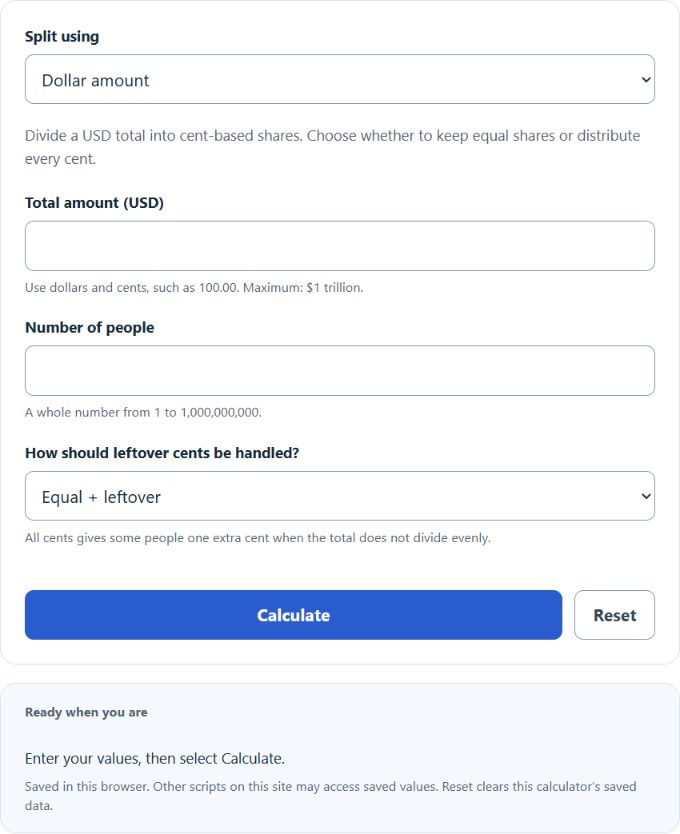
Split a USD amount into cent-based shares, or total your cash and divide its value while assuming you can make change. Choose identical shares with a visible leftover or distribute every cent.
- All Personal Finance Calculators
- Division Calculator
- Multiplying Percentages Calculator
- Prize Money Split Calculator
Money Division Formula
The following formula is used to calculate money division.
- Where MD is the divided money per share ($)
- D is the total dollar amount ($)
- X is the number of equal shares
Divide the total by the number of recipients. When the result does not divide evenly to a whole cent, a rounding decision is required (see the Cent Remainder Problem below).
Money Division Definition
What is money division? Money division is the allocation of a monetary total into a specified number of shares using arithmetic. Unlike abstract division, currency is constrained by its smallest denomination (1 cent in USD), meaning exact equal splits are only possible when the total in cents is divisible by the number of recipients without a remainder.
The Cent Remainder Problem
When the total does not divide evenly to a whole cent, decide how to handle the remaining cents. Allocation methods and rounding rules serve different purposes:
- Equal whole-cent shares with a remainder: Give each person the same whole-cent amount, rounded down, and keep the unallocated cents visible as a remainder. The recipients can agree separately on what to do with that remainder.
- Largest remainder method: Give each recipient the whole-cent part of their share, then allocate the remaining cents one at a time in descending order of fractional remainder. Equal shares have tied remainders, so an agreed tie-breaking rule is needed. This is an allocation option, not a universal payroll or dividend requirement.
- Banker’s rounding (round half to even): An exact half-cent tie is rounded to the nearest even cent. This is a rounding rule; rounding each share separately does not guarantee that the shares add up to the original total.
Example: $100.00 split 3 ways = $33.333… Giving each person $33.33 allocates $99.99 and leaves $0.01. To allocate the full $100.00, one person can receive $33.34 and the other two $33.33. Because the fractional remainders are equal, agree on who receives the extra cent.
Equal vs. Proportional Division
Equal division assigns identical shares regardless of contribution, consumption, or wealth. Proportional division weights each share by a factor such as income, consumption, or ownership stake. The right method depends on context:
- Restaurant bills: An equal split gives each diner the same share. An itemized split assigns costs according to what each person ordered; agree on how to handle tax, tips and shared items.
- Shared rent: Roommates can agree on equal shares or a weighted split, for example by room size. The calculator computes an equal split and does not decide what is fair.
- Business partnerships: Distributions depend on the partnership agreement and applicable law. Ownership percentages alone do not establish a universal distribution rule.
- Estates and inheritance: A will or applicable intestacy law determines who inherits and in what shares. Intestacy depends on the jurisdiction and family relationships; it does not mean equal shares for named beneficiaries.
- Dividend distributions: Payment depends on the declared dividend and the rights of the eligible share class. This equal-split calculator does not determine dividend entitlement.
Example Problem
How to do money division?
- First, determine the initial amount.
The initial dollar amount for this example that we will be splitting is $100.00.
- Next, determine the number of ways to split the money.
For this example, the money will be divided 10 ways.
- Finally, calculate the new value.
Using money division, the original value is divided by 10 to get our equal split amount. 100/10 = $10.00.
About Money Division
What is money division used for? Any time a total monetary value must be allocated across multiple parties, money division is the core mechanism. Practical contexts include splitting restaurant checks, distributing payroll bonuses, allocating partnership profits, settling estates, and dividing prize pools. The arithmetic is straightforward; the real decisions involve whether to split equally or proportionally, and how to handle the cent-level rounding that arises when totals are not evenly divisible.