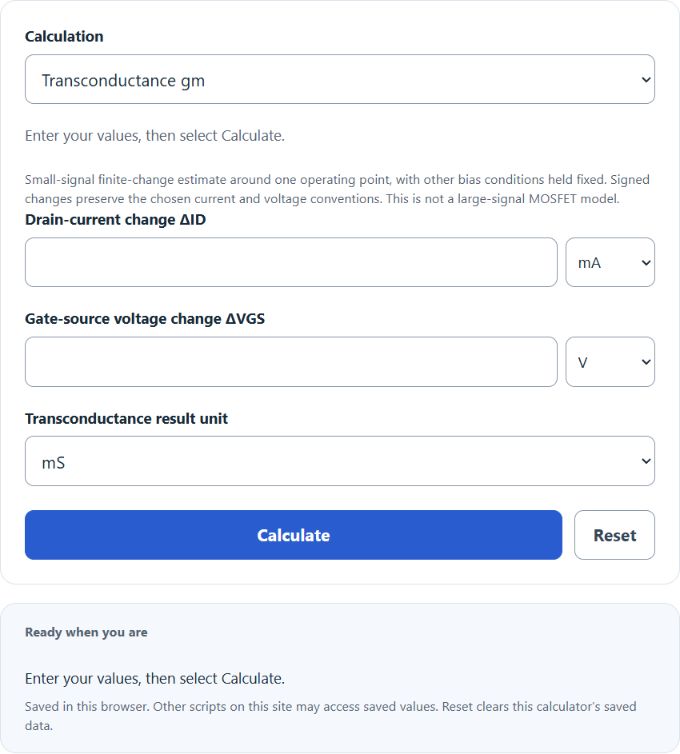
Estimate MOSFET transconductance from a small drain-current change and gate-source voltage change around an operating point. You can also solve either change from a specified transconductance.
Small-signal relation
gm ≈ ΔID/ΔVGS; ΔID ≈ gm × ΔVGS; ΔVGS ≈ ΔID/gm. The derivative definition is gm = ∂ID/∂VGS with the other bias conditions held fixed.
| Unit | Equivalent |
|---|---|
| 1 S | 1 A/V |
| 1 mS | 0.001 S |
| 1 µS | 0.000001 S |
Example
A 2 mA drain-current change over a 0.1 V gate-source change gives gm ≈ 0.002/0.1 = 0.02 S, or 20 mS. At that same local slope, a 10 mV change gives approximately 0.2 mA.
Frequently asked questions
Can changes be negative?
Yes. Enter signed changes consistently with your current and voltage reference directions; the result preserves their signs.
Is a finite-change ratio the exact transconductance?
It is an average slope over the entered interval. A sufficiently small interval approximates the local derivative.
Why must some denominators be nonzero?
A zero voltage change cannot determine a slope. A zero gm cannot determine a unique voltage change from zero current change, or explain a nonzero current change.
Reference: MIT MOSFET small-signal model lecture.