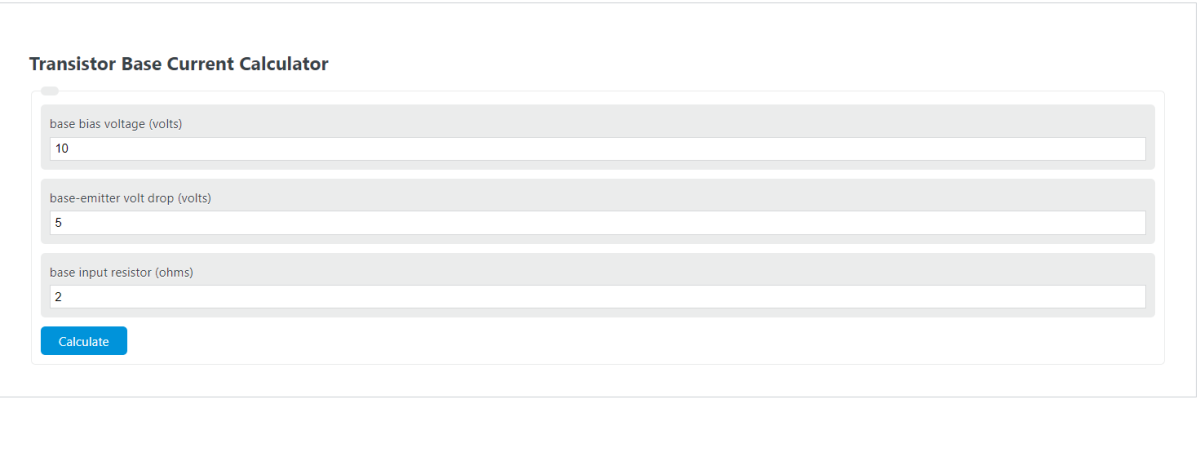
Calculate transistor base current, base input resistor, bias voltage, or V_BE, and size a switching base resistor from drive voltage, I_C, and β.
- All Physics Calculators
- All Electrical Calculators
- Instantaneous Current Calculator
- Capacitor Charge Current Calculator
- Fault Current Calculator
- Shunt Current Calculator
- Inverter Current Calculator
- MOSFET Transconductance Calculator
Transistor Base Current Formula
The following formula is used to calculate the transistor base current for the common case where a voltage source drives the base through a single series resistor, and the emitter is at the reference (ground) node.
- Where IB is the transistor base current (amps)
- VB is the base drive (bias) voltage applied to the resistor, relative to the emitter (volts)
- VBE is the base-emitter voltage drop while conducting (volts; typically ~0.6–0.8 V for silicon BJTs, depending on current and temperature)
- RB is the base resistor (ohms)
To calculate the transistor base current, subtract the base-emitter voltage drop from the base drive voltage, then divide by the base resistor.
If VB ≤ VBE, this idealized formula gives zero or negative current; in practice the transistor is off and IB is approximately 0 A (ignoring leakage).
How to Calculate Transistor Base Current?
The following example problems outline how to calculate Transistor Base Current.
Example Problem #1
- First, determine the base bias voltage (volts). In this example, the base bias voltage is determined to be 5 V.
- Next, determine the base-emitter voltage drop (volts). For this problem, the base-emitter voltage drop is measured/assumed to be 0.7 V.
- Next, determine the base input resistor (ohms). In this case, the base input resistor is found to be 1000 Ω.
- Finally, calculate the Transistor Base Current using the formula above:
Ib = ( Vb – Vbe) / Rb
Inserting the values from above and solving yields:
Ib = ( 5 – 0.7) / 1000 = 0.0043 (amps) = 4.3 mA
Example Problem #2
Using the same method as above, determine the variables required by the formula. For this example problem, these are:
base bias voltage (volts) = 3.3
base-emitter volt drop (volts) = 0.7
base input resistor (ohms) = 2200
Enter these given values into the calculator above to get:
Ib = ( 3.3 – 0.7) / 2200 = 0.00118 (amps) = 1.18 mA