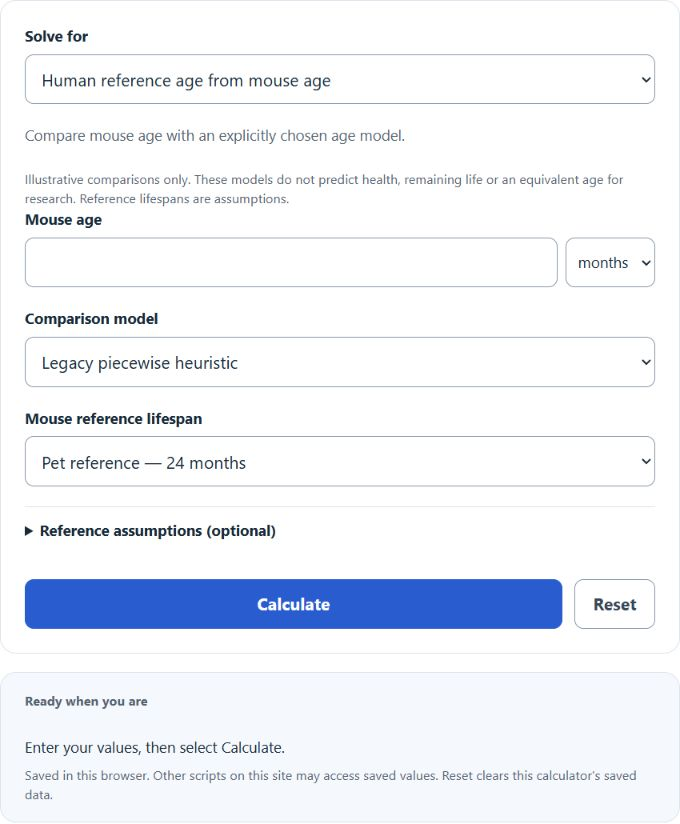
Compare mouse and human reference ages using a chosen illustrative model, calculate mouse age from birth dates, or plan an age target date. These comparisons do not predict health, remaining life or a research-equivalent age.
Related Calculators
- Coat Color Calculator
- Centimorgan To Percentage Calculator
- Heritability Coefficient Calculator
- Genetic Linkage Distance
- All Biology Calculators
Mouse to Human Age Formula
There is no single universally accepted mouse-to-human age conversion. Mice mature very rapidly early in life and then age more slowly, so a simple one-line linear formula can be misleading. The Article anchor interpolation option uses the explicitly stated reference points below. These are article assumptions, not a validated universal biological-age standard. The default Legacy piecewise heuristic uses a different mathematical rule; Equal lifespan fractions uses the chosen mouse and human reference lifespans.
Variables:
- H is the illustrative human reference age in years
- Md is the mouse age in days (postnatal)
For Article anchor interpolation, convert mouse age to days (years × 365.25; average months × 30.4375), then linearly interpolate between the adjacent reference points. Reverse the axes to find mouse age from human reference years. Outside the final point the last segment is extrapolated. The other two selectable models use different formulas, shown in Calculation details.
| Mouse Age (years) | Human Age (years, approx.) |
|---|---|
| ¼ | 18.9 |
| ½ | 27.2 |
| ¾ | 35.6 |
| 1 | 41.9 |
| 1¼ | 47.7 |
| 1½ | 56.5 |
| 1¾ | 62.8 |
| 2 | 69.0 |
| 2¼ | 75.3 |
| 2½ | 81.5 |
| 2¾ | 87.8 |
| 3 | 94.0 |
| Model used: Article anchor interpolation between assumed points (mouse days → human reference years): (0,0), (60,16), (300,38), (450,47), (540,56), (730,69), with 365.25 days per year. Beyond 730 days the last segment is extrapolated. This is not an official JAX conversion standard or an individual survival prediction. | |
What is a Mouse to Human Age Calculator?
A Mouse to Human Age Calculator compares ages under an explicitly chosen mathematical model. Biological age mapping depends on strain, sex, environment and the outcome being studied; this tool cannot establish an equivalent research age, diagnose a pet or predict survival. Preset mouse lifespans are illustrative reference values, not established strain-specific medians. Disease-specific research demonstrates why a single universal conversion is inappropriate.
How to Calculate Mouse to Human Age?
The following steps outline how to calculate the Mouse to Human Age.
- Determine the mouse age.
- Choose the age unit; the calculator uses 365.25 days per year and 30.4375 per average month.
- Choose Legacy piecewise heuristic, Article anchor interpolation, or Equal lifespan fractions, and set any reference assumptions.
- Select Calculate to apply the chosen model; review its assumptions in Calculation details.
- Treat the answer as an illustrative comparison, not a biological equivalence or time-remaining estimate.
Example Problem :
Use the following variables as an example problem to test your knowledge.
Mouse Age (M) = 2 years = 730.5 days; choose Article anchor interpolation
Human reference age (H) ≈ 69.0342 years, displayed as 69.0342 in the calculator (69.0 in the one-decimal table).