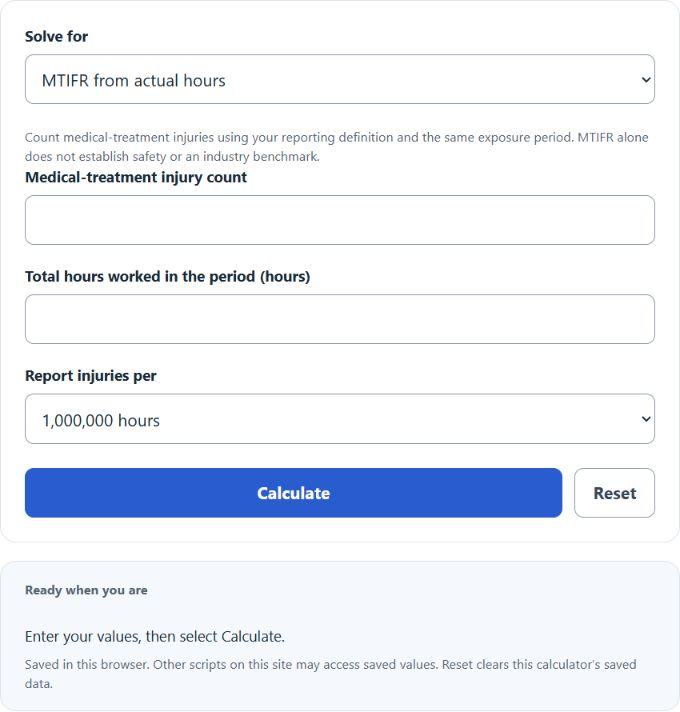
Calculate medical-treatment injury frequency from actual hours worked or a staff-hour estimate, using the selected reporting scale.
Related Calculators
- Severity Rate Calculator
- Lost Time Incident Rate Calculator
- Accident Frequency Rate Calculator
- Accident-Free Man-Hours Calculator
- Accident-Free Days Calculator
- Lost Work Day Calculator
- All Unit Converters
Medical Treatment Injury Frequency Rate Formula
Variables:
- Rate is the medical-treatment injury frequency rate (MTIFR)
- Cases is the medical-treatment injury count under your reporting definition
- Hours Worked is the total hours worked in the same period
- N is the normalization factor (common values include 200,000 hours for OSHA TRIR/DART and 1,000,000 hours for some MTIFR/LTIFR reporting)
To calculate a rate, divide the applicable case count by the total hours worked in the period, then multiply by the chosen normalization factor (such as 200,000 or 1,000,000 hours).
How to Calculate Medical Treatment Injury Frequency Rate?
The following steps outline how to calculate the Medical Treatment Injury Frequency Rate.
- First, determine the total number of medical treatment injuries (cases) during the period.
- Next, determine the total hours worked during the same period.
- Next, gather the formula from above: Rate = Cases / Hours Worked × Normalization Factor.
- Finally, calculate the Medical Treatment Injury Frequency Rate.
- After inserting the variables and calculating the result, check your answer with the calculator above.
Example Problem :
Use the following variables as an example problem to test your knowledge.
total number of medical treatment injuries (cases) in the period = 500
total hours worked in the period = 30,000
MTIFR = (500 / 30,000) × 1,000,000 = 16,666.67 medical treatment injuries per 1,000,000 hours.
FAQ
What is the significance of calculating the Medical Treatment Injury Frequency Rate?
Calculating the Medical Treatment Injury Frequency Rate (MTIFR) helps organizations understand the frequency of injuries requiring medical treatment. It is useful for assessing workplace safety, identifying areas for improvement, and implementing measures to reduce the risk of injuries.
How can organizations use the MTIFR to improve workplace safety?
Organizations can use the MTIFR as a benchmark to evaluate the effectiveness of their safety protocols and training programs. By tracking this rate over time, they can identify trends, determine the impact of safety initiatives, and make informed decisions to further reduce the frequency of injuries.
Are there any limitations to using the MTIFR as a safety indicator?
While the MTIFR is a valuable tool for measuring the frequency of injuries requiring medical treatment, it does not account for injury severity or near misses. Therefore, it should be used in conjunction with other safety metrics for a comprehensive understanding of workplace safety.
Can the MTIFR calculation be applied to any industry?
Yes, the MTIFR calculation can be applied across various industries to measure the frequency of injuries requiring medical treatment. However, benchmark rates may vary by industry, reflecting different levels of risk and safety standards. It’s important for each organization to consider its specific context when interpreting MTIFR values.
Where can I find official OSHA definitions for TRIR and DART inputs?
For TRIR and DART, consult OSHA recordkeeping rules and guidance (29 CFR 1904) to classify “recordable” incidents, days away from work, and restriction/transfer cases correctly, and use your OSHA logs as the source of counts: OSHA 29 CFR 1904.