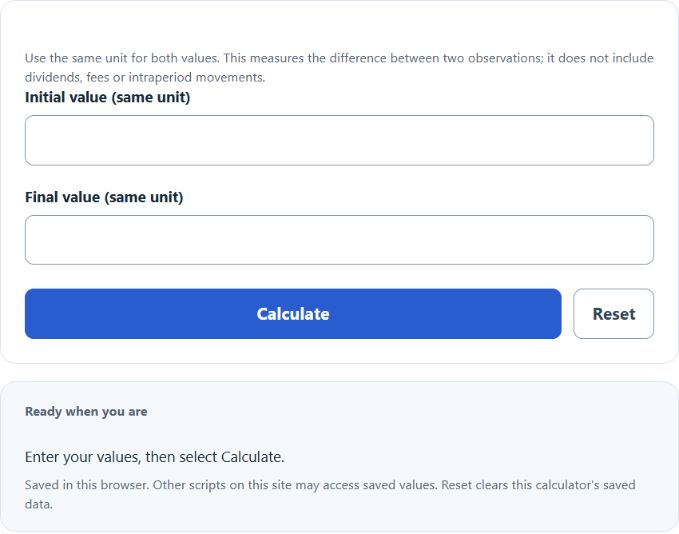
Calculate net change and percentage change from two values in the same unit, such as consecutive closing prices.
Related Calculators
- Rate of Change Calculator
- Percent Overshoot Calculator
- Fold Increase Calculator
- Reverse Percentage Calculator
- All Math and Numbers Calculators
Net Change Formula
The net change of a security or asset is calculated by subtracting the previous period's closing price from the current period's closing price.
- NC = net change (in the same units as the price, e.g., dollars, euros)
- CP = current period closing price
- PP = previous period closing price
To express the net change as a percentage, divide by the initial value, which must be nonzero. A negative initial value produces a signed-baseline ratio whose sign can differ from the direction of the absolute change:
A positive result indicates price appreciation. A negative result indicates depreciation. This metric is the single most common figure displayed next to a ticker symbol on stock exchanges, brokerage dashboards, and financial news tickers around the world.
What Net Change Tells Investors
Net change distills all of the buying and selling activity during a trading session into a single number. Every trade, limit order, market order, and block transaction that occurs between the opening bell and the closing bell is reflected in that final closing price difference. When a stock shows a net change of +$2.50 on a day with 15 million shares traded, it means that, on balance, buyers were willing to pay $2.50 more per share than the previous session's final consensus price.
This figure matters because closing prices are the basis for portfolio valuation, margin calculations, options settlement, and index rebalancing. A fund's NAV reflects portfolio valuations and other assets and liabilities; total investment return also depends on distributions and costs. Index providers like S&P Dow Jones and FTSE Russell use closing prices to compute index levels, which in turn drive trillions of dollars in passive fund allocations.
Net Change Across Asset Classes
Net change applies to any asset with a quoted price, but the conventions and typical magnitudes differ by market. The table below uses illustrative changes to show quotation units. They are examples, not typical daily ranges or forecasts; closing and settlement conventions depend on the provider and product.
| Asset Class | Illustrative Change | Quote Convention | Closing Price Basis |
|---|---|---|---|
| U.S. Large-Cap Stocks | +$1 per share | Dollars per share | Regular session close |
| U.S. Treasury Bonds (10-Year) | +12/32 of a point | Points and 32nds of par | Provider-defined closing price |
| Crude Oil (WTI Futures) | +$1 per barrel | Dollars per barrel | Contract-defined settlement |
| Gold (Spot) | +$10 per ounce | Dollars per troy ounce | Specified benchmark or timestamp |
| EUR/USD (Forex) | +50 pips | Pips (0.0001 units) | Provider-defined rollover |
| S&P 500 Index | +20 points | Index points | Calculated from component closes |
| Bitcoin | +2% of price | Dollars per coin | Specified observation times |
Bonds present a unique case because their net change is quoted in points and 32nds of par value. A net change of "+12/32" on a 10-year Treasury means the bond's price rose by 12/32 of 1% of its $1,000 face value, or $3.75 per bond. Forex pairs have no official closing time since the market operates 24 hours on weekdays, so brokers conventionally use the 5:00 PM Eastern Time rollover as the reference point for calculating daily net change.
Net Change vs. Percent Change
Net change and percent change answer different questions about the same price movement. Net change reports the raw dollar (or unit) difference and directly tells a shareholder the gain or loss per share held. An investor holding 500 shares of a stock with a net change of +$3.00 gained exactly $1,500 in market value that day, regardless of share price level.
Percent change normalizes the movement relative to the starting price, making it possible to compare securities at different price levels. A $2 net change on a $20 stock is a 10% move, while a $2 net change on a $200 stock is only 1%. Screening tools, heatmaps, and relative performance charts almost always use percent change for cross-asset comparison. Net change, however, remains essential for calculating actual dollar profit and loss, margin requirements, and options pricing adjustments.
Factors That Drive Net Change
The net change of a security on any given day is the product of all supply and demand forces acting on it. The most significant drivers include company earnings reports, which can produce net changes of 5% to 20% or more in a single session. Macroeconomic data releases (employment numbers, inflation reports, GDP figures, Federal Reserve interest rate decisions) move entire sectors simultaneously. Analyst upgrades, downgrades, and price target revisions shift institutional order flow and often trigger net changes within minutes of publication.
After-hours and pre-market trading can also affect the perceived net change. If a stock closes at $100, trades at $105 in after-hours, but then opens the next regular session at $103 and closes at $104, the official net change is +$4 (from $100 to $104). The after-hours peak of $105 is not captured in the net change figure, which only compares closing prices. This gap between sessions is one reason that net change alone does not capture intraday volatility or risk.
Upticks, Downticks, and the Tick Rule
Each individual trade that contributes to the eventual net change is classified as either an uptick or a downtick. An uptick occurs when a trade executes at a price higher than the immediately preceding trade; a downtick occurs when it executes lower. The NYSE TICK index aggregates this data across all listed stocks, showing the net number of stocks on an uptick minus those on a downtick at any moment. Readings above +1,000 indicate broad buying pressure, while readings below -1,000 signal broad selling pressure.
The SEC's alternative uptick rule (Rule 201), adopted in 2010, restricts short selling on any stock whose price has dropped 10% or more from the previous close. Once triggered, covered short sales are generally restricted at or below the current national best bid for the remainder of the day and the following day, subject to the rule’s exceptions. This rule directly ties to net change because the 10% threshold is measured from the prior close, the same reference point used to calculate net change.
Limitations of Net Change
Net change has several well-known blind spots. It ignores everything that happened between the two closing prices. A stock that opens sharply lower, recovers throughout the day, and closes flat will show a net change of zero despite significant intraday volatility. Traders who measure risk using only net change will underestimate the true range of price movement.
Net change also does not account for dividends, stock splits, or other corporate actions. On an ex-dividend date, a stock's price typically drops by approximately the dividend amount at the open. The resulting negative net change reflects the dividend distribution, not a loss in company value. Adjusted close prices correct for these events, but the raw net change figure does not. Similarly, after a 2-for-1 stock split, the closing price is halved, and comparing it to the pre-split close would produce a misleading net change of roughly -50%. Financial data providers adjust historical prices to prevent this distortion, but real-time ticker displays may briefly show unadjusted figures.
FAQ
Net change in stocks is the difference between the current closing price and the previous closing price. It is the primary figure displayed next to a ticker symbol on trading platforms and financial news. A positive net change (shown in green on most platforms) means the stock closed higher, and a negative net change (shown in red) means it closed lower.
No. Net change is the absolute difference in price (e.g., +$3.00), while percent change expresses that difference as a proportion of the previous closing price (e.g., +2.4%). Net change is useful for calculating dollar profit or loss on a position, while percent change is better for comparing relative performance across different securities.
No. On an ex-dividend date, a stock's price drops by roughly the dividend amount. This shows as a negative net change even though shareholders received the dividend as cash. Adjusted close prices correct for dividends, but the standard net change figure displayed on tickers does not.
After-hours trades are not included in the official closing price used to calculate net change. However, after-hours activity can influence the next day's opening price, which then affects that session's net change. For example, positive earnings released after hours may cause a gap-up open the following morning.