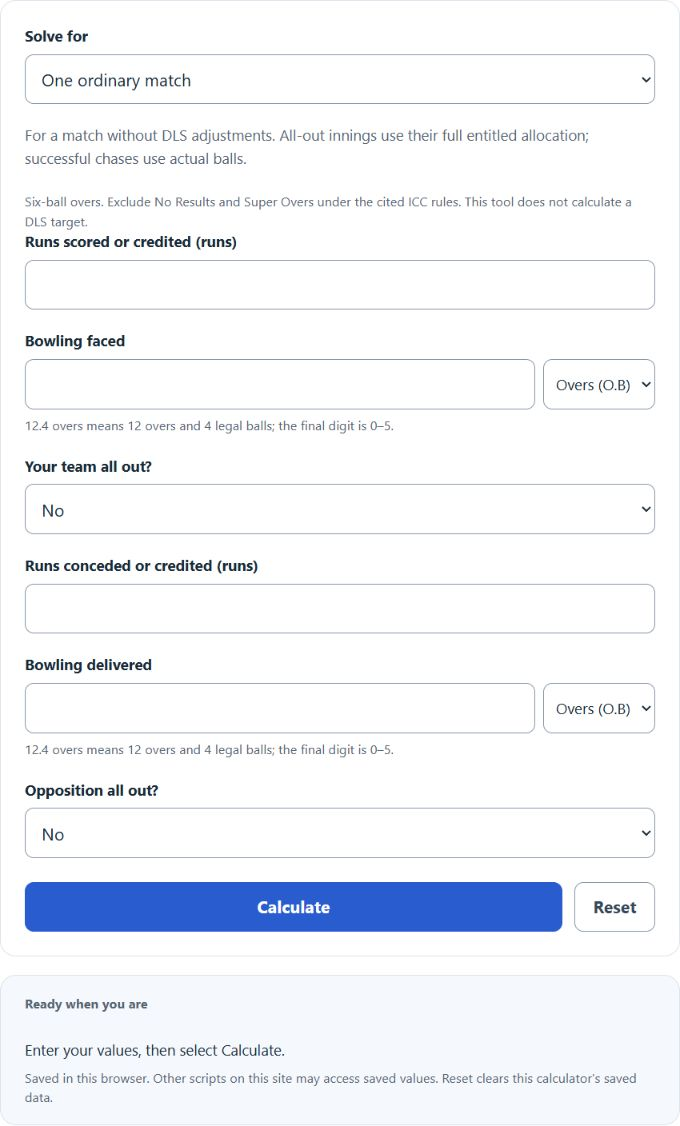
Calculate cricket net run rate for an ordinary match or from adjusted tournament totals, using the correct credited overs for each innings.
Net Run Rate Formula
NRR = 6 × credited runs for / credited balls faced − 6 × credited runs against / credited balls bowled
Start with the Right Scope
Choose one ordinary match when neither innings requires a rain-rule adjustment. Enter both scores and the actual legal bowling amounts. Mark either side all out when appropriate and supply that side’s full entitled allocation. For a season, tournament group, or rain-adjusted match, choose adjusted tournament totals and enter the already credited runs and balls. A published NRR alone is not enough to recover those four totals.
Why All-Out Overs Matter
An innings that ends all out before its allocation is exhausted is charged the full entitled quota for NRR. For example, 100 all out after 15 overs in a 20-over allocation contributes a scoring rate of 5.000, rather than 6.667. The calculator checks that actual bowling does not exceed the allocation. An early successful chase uses its actual legal balls.
Worked Match Example
Suppose your team scores 180 from 20 overs and concedes 160 from 20 overs. The two scoring rates are 9.000 and 8.000, so the match NRR is +1.000 runs per over. If the opposition instead reaches 181 in 19.2 overs, convert 19.2 to 116 balls. Its rate is 181 × 6 / 116 = 9.362069, giving your team an NRR of −0.362 after display rounding.
Combine Totals Before Dividing
For multiple eligible matches, sum credited runs scored, credited balls faced, credited runs conceded, and credited balls bowled. Then evaluate the formula once. Do not average match NRRs. For example, scoring 200 from 20 overs and 100 from 10 overs gives 300 from 30 overs and a rate of 10.000. Different innings lengths give different statistical weights.
Rain Results and Exclusions
Under the cited ICC conditions, exclude Super Overs and no-results. A completed DLS-adjusted match credits Team 1 with the final target minus one from Team 2’s allocated overs. If abandonment produces a DLS result, use Team 2’s par score and faced overs for Team 1. Apply the competition’s forfeit provisions separately. Enter those adjusted quantities in totals mode.
Read Overs as a Ball Count
The input unit selector accepts cricket overs or legal balls. An entry of 12.4 overs means 76 legal balls. It does not mean 12.4 × 6 balls. Convert each innings to balls before summing it, particularly when several partial overs are involved. Values such as 12.6 and 12.40 are rejected rather than silently reinterpreted.
Interpret the Sign and Precision
A positive result means your team’s aggregate scoring rate exceeds the rate scored against it. A negative result means the reverse. The tool subtracts unrounded rates and displays three decimal places, so subtracting the displayed component rates can occasionally differ in the last digit. The result alone does not determine standings, because points and other tie-break criteria also matter.
Assumptions and Limits
This tool assumes six-ball overs. Both credited denominators must be positive, and runs and balls must be whole counts. It does not decide whether a match qualifies for NRR, reconstruct resource percentages, obtain live results, or calculate a DLS target. A tournament organizer’s current playing conditions determine the credited inputs.
Reference Table
| Innings example | Credited bowling | Scoring rate |
|---|---|---|
| 180 from 20 overs, not all out | 120 balls | 9.000 runs/over |
| 100 all out in 15 of 20 overs | 120 balls | 5.000 runs/over |
| 101 in a successful 12.4-over chase | 76 balls | 7.974 runs/over |
| Two eligible innings: 180/20 and 120/15 | 210 balls | 8.571 runs/over |
Sources
ICC, Men’s T20 World Cup Playing Conditions, 2026, clause 16.10.7. MCC, Laws of Cricket, Law 17, The Over.