Calculate a bowler’s runs conceded per over, or find a maximum run allowance and minimum bowling amount for a target economy.
Cricket Economy Rate Formula
Economy rate = bowler-charged runs × 6 / legal balls bowled
Choose Matching Inputs
Use the runs charged to the bowler. Wides and no-balls are included in those figures; byes and leg byes are not. Use the official bowling analysis when special penalties affect attribution. The legal-ball count remains separate from the total number of delivery events.
What the Rate Describes
Economy describes the rate at which a bowler concedes charged runs. It does not include wickets, so two spells can have identical economy with very different dismissal outcomes. This calculation uses actual legal bowling rather than an all-out allocation used for team NRR.
Worked Example
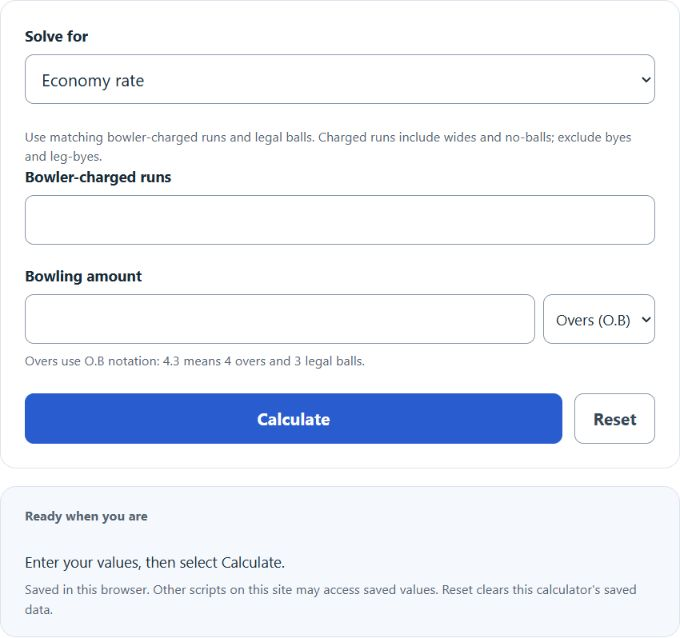
For 25 charged runs from 4.3 overs, the calculation is 25 × 6 / 27 = 5.56 runs per over. Select the default rate mode, enter those values, and compare the primary answer with the run and ball totals in the result details. The denominator must contain at least one ball; zero runs with a positive ball count is a valid zero rate.
Whole-Count Target Modes
For 27 balls and a target economy of at most 5.5, the maximum whole-run allowance is floor(5.5 × 27 / 6) = 24. With 25 charged runs fixed, at least ceiling(25 × 6 / 5.5) = 28 balls, or 4.4 overs, are needed to meet that target. The target modes use the chosen rate as a threshold. They do not reverse-engineer an exact historical count from a rounded statistic.
Why Rounding Has a Direction
A run allowance rounds down because one extra run could breach the target economy. A required bowling amount rounds up because too few balls would leave the economy above the target. With zero runs, at least one legal ball is used so the resulting rate is defined.
Combine Records Using Totals
A spell of 25 runs from 27 balls and another of 18 from 24 balls combine to 43 charged runs from 51 legal balls. The aggregate economy is 43 × 6 / 51 = 5.06 runs per over. Do not take the unweighted average of the two displayed spell economies.
Read Cricket Overs Correctly
In the adjacent unit selector, cricket overs use a single extra-ball digit from 0 to 5. For example, 4.3 is 27 legal balls and 4.5 is 29. Decimal overs are shown separately in the result. Convert partial overs to balls before adding periods, and reject entries such as 4.6 or 4.30 instead of treating them as decimal values.
Assumptions and Limits
Inputs must describe the same sample and use the displayed units. Inverse ball calculations require a positive target rate. The tool does not check the bowler’s remaining quota or predict future runs. Rates normally display to two decimal places; very small nonzero rates retain meaningful precision, while the whole-count target arithmetic uses the entered target precision. Count inputs and calculated counts are limited to one billion.
Reference Table
| Sample | Rate | Interpretation |
|---|---|---|
| 25 runs / 4.3 overs | 5.56 | 27 legal balls |
| 24 runs / 4.3 overs | 5.33 | Within a 5.50 target |
| 25 runs / 4.4 overs | 5.36 | Minimum 28 balls at target 5.50 |
| 0 runs / 1 legal ball | 0.00 | Valid zero economy |
Sources
MCC, Laws of Cricket, Laws 17, 18, 21, 22 and 23. Cricket Australia, bowling statistics fields, accessed September 2026.