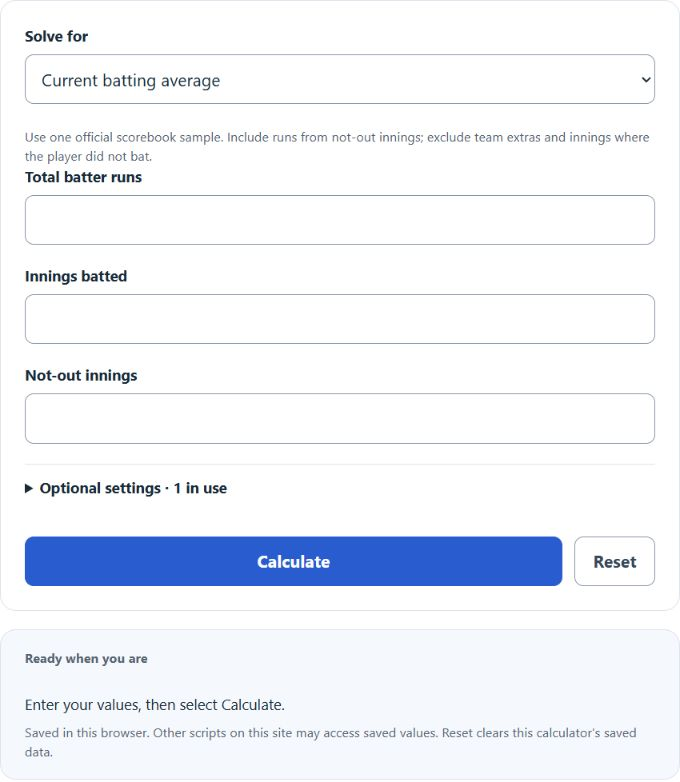
Calculate batting average from runs, innings, and not outs, then explore a next innings or a future run target.
Cricket Batting Average Formula
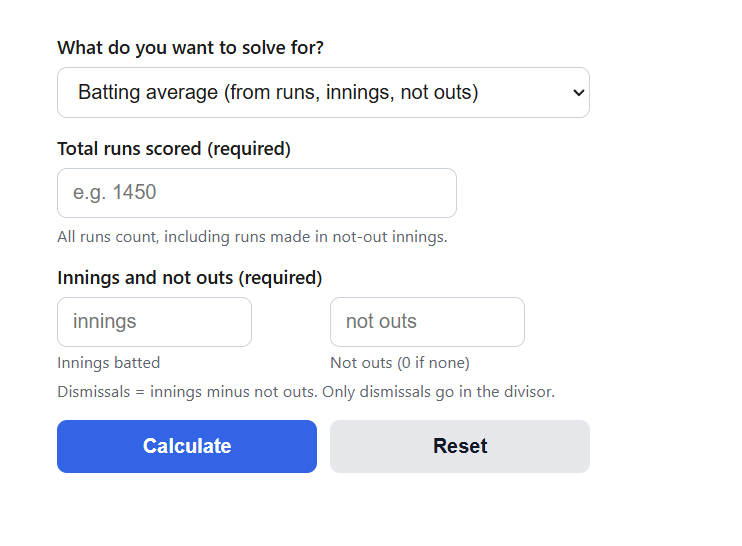
Dismissals = innings batted − not outs; batting average = total batter runs / dismissals
Enter a Consistent Record
Use total batter runs, innings actually batted, and not-out innings from the same sample. Do not enter team totals, matches selected, or innings where the player did not bat. Include runs scored in not-out innings. The tool checks that not outs do not exceed innings and that positive runs are not paired with zero innings.
Current Average
Choose Current batting average to divide runs by dismissals. The supporting results also show runs per innings, which uses a different denominator. This helps explain how not outs affect the average without assigning a performance label. If there are no dismissals, the batting average is undefined even when the player has scored runs. Traditional scorebook display truncates to two decimals, following the ACS convention. The optional rounded display uses nearest rounding; it does not change exact target-run calculations.
Worked Example
A player scores 600 runs in 20 innings and finishes not out five times. Dismissals are 20 − 5 = 15, and the batting average is 600 / 15 = 40.00 runs per dismissal. Runs per innings is 600 / 20 = 30.00. Both numbers describe the same sample, but they answer different questions.
Project the Next Innings
Choose Average after next innings, enter the additional runs, and state whether the player is dismissed. From the example, 40 runs followed by a dismissal gives 640 / 16 = 40.00. Finishing 40 not out gives 640 / 15 = 42.66. The innings count increases in both cases, but the dismissal count increases only when the player is out.
Find Runs Needed for a Target
Choose Runs needed for a target average. Enter the average and the number of additional dismissals expected by that point. For the example, reaching 45 after two more dismissals requires at least 45 × 17 = 765 total runs, or 165 additional runs. If the current runs already meet the threshold, the extra-run result is zero.
How the Target Is Rounded
Run totals must be whole numbers. A target product of 765.1 means at least 766 total runs, so the calculator rounds up before subtracting the existing runs. It reports the average achieved by the resulting counts. Use the full target precision when a one-run boundary matters rather than a rate rounded from another scorecard.
Combine Innings Without Averaging Averages
Add the runs, innings, and not outs from each period first. Then compute dismissals and divide once. An arithmetic mean of monthly averages can weight a one-dismissal month as heavily as a ten-dismissal month. Runs made in a period with no dismissals must still be included in the larger sample.
Assumptions and Limits
Future dismissals are a scenario input, not a prediction of innings outcomes. A target average needs at least one total dismissal. Target zero is permitted when that denominator exists. The tool does not classify retired-out cases or other scoring decisions; use the official record’s innings and dismissal convention.
Reference Table
| Record or scenario | Dismissals | Average |
|---|---|---|
| 600 runs, 20 innings, 5 not outs | 15 | 40.00 |
| Then 40 and dismissed | 16 | 40.00 |
| Then 40 not out | 15 | 42.66 |
| Then 0 and dismissed | 16 | 37.50 |
| 100 runs, 3 innings, all not out | 0 | Not defined |
Sources
Cricket Australia, player statistics fields for runs, innings, not outs and batting average, accessed September 2026. MCC, Laws of Cricket, Law 18, Scoring Runs. Association of Cricket Statisticians and Historians, FAQ 2022, section 2: averages and traditional truncation.