Calculate batting runs per 100 balls faced, or find a minimum run target and maximum ball budget at a chosen strike rate.
Batting Strike Rate Formula
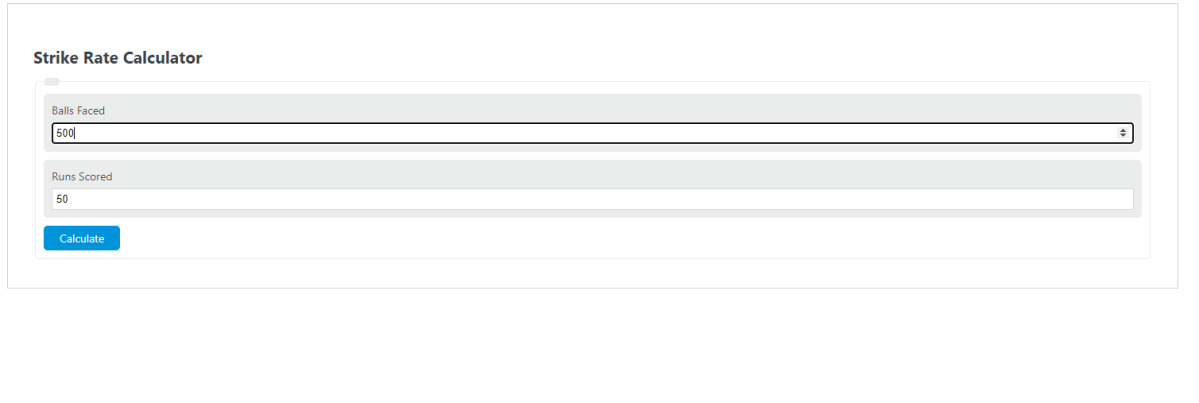
Batting strike rate = batter runs × 100 / recorded balls faced
Choose Matching Inputs
Use the batter’s own runs and recorded balls faced. Team extras do not become batter runs. The scorer’s balls-faced statistic is the required denominator; it need not equal team legal balls or every delivery sent down.
What the Rate Describes
A strike rate of 150 means 150 runs per 100 balls at the observed pace. It is not a 150% probability, and it is not the percentage of deliveries that produced a scoring shot.
Worked Example
For 75 runs from 50 balls, the calculation is 75 × 100 / 50 = 150.00 runs per 100 balls. Select the default rate mode, enter those values, and compare the primary answer with the run and ball totals in the result details. The denominator must contain at least one ball; zero runs with a positive ball count is a valid zero rate.
Whole-Count Target Modes
A target of 133.33 from 31 balls requires ceiling(133.33 × 31 / 100) = 42 runs. With 41 runs fixed, the maximum ball budget at the same target is floor(41 × 100 / 133.33) = 30 balls. The target modes use the chosen rate as a threshold. They do not reverse-engineer an exact historical count from a rounded statistic.
Why Rounding Has a Direction
Minimum runs round up so the target is reached or exceeded. A maximum ball budget rounds down so the fixed runs maintain the target pace. If the budget is zero, the result explains that no positive ball count meets that target; it does not claim a meaningful zero-ball scoring rate.
Combine Records Using Totals
A 10-run innings from 10 balls has a strike rate of 100; a 90-run innings from 50 balls has 180. Together they are 100 runs from 60 balls, or 166.67. Averaging 100 and 180 would incorrectly give 140.
Recorded Balls Faced
Take balls faced directly from the scoring record. It is not the same concept as every delivery bowled to the player or the team’s elapsed over count. Enter whole balls and whole runs. A target rate may contain up to six decimal places, which helps avoid one-run changes caused by premature rounding.
Assumptions and Limits
Inputs must describe the same sample and use the displayed units. Inverse ball calculations require a positive target rate. The tool does not predict future scoring or account for wickets, field settings, or match conditions. Rates display to two decimal places, while the whole-count target arithmetic uses the entered target precision. Count inputs and calculated counts are limited to one billion.
Reference Table
| Sample | Rate | Interpretation |
|---|---|---|
| 75 runs / 50 balls | 150.00 | Runs per 100 balls |
| 0 runs / 20 balls | 0.00 | Valid zero scoring rate |
| 42 runs / 31 balls | 135.48 | Meets a 133.33 target |
| 41 runs / 30 balls | 136.67 | 31 balls would fall below 133.33 |
Sources
ICC, Gilchrist smashes exceptional 100th six in Tests, 2010. MCC, Laws of Cricket, Law 18, Scoring Runs.
