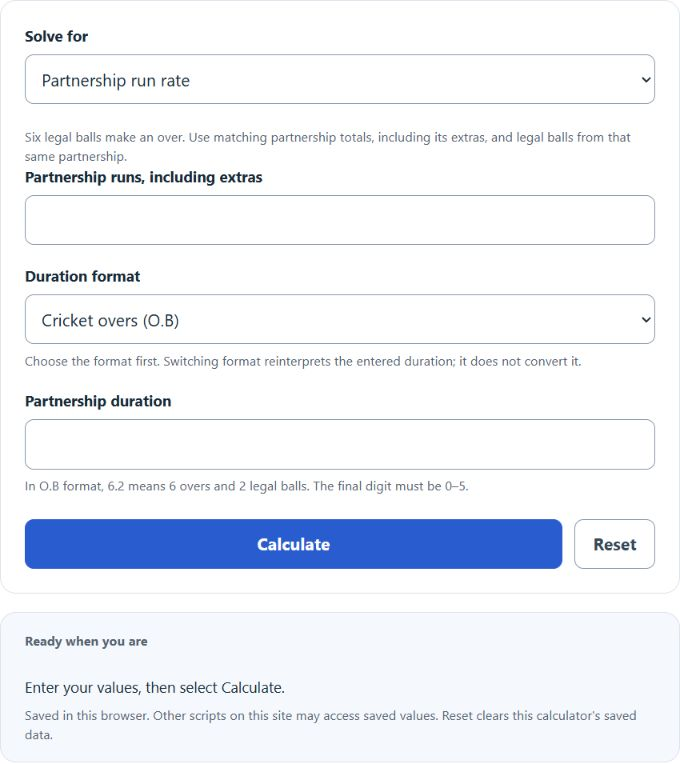
Calculate the scoring rate of a cricket partnership from its total runs and legal-ball duration, or set a run target and ball budget.
Partnership Run Rate Formula
Partnership run rate = partnership runs × 6 / legal balls in the partnership
Choose Matching Inputs
Use runs credited to the partnership, including its extras, and the legal-ball duration of that same partnership. Do not substitute one batter’s runs or the innings score at its end. Use the scorebook’s partnership total when a wicket delivery or scoring adjustment makes simple subtraction ambiguous.
What the Rate Describes
A partnership rate describes how quickly the team score advanced while the pair was together. It does not split credit between batters, describe their individual strike rates, or establish whether the partnership was good for the match situation.
Worked Example
For 50 partnership runs from 6.2 overs, the calculation is 50 × 6 / 38 = 7.89 runs per over. Select the default rate mode, enter those values, and compare the primary answer with the run and ball totals in the result details. The denominator must contain at least one ball; zero runs with a positive ball count is a valid zero rate.
Whole-Count Target Modes
At a target of 8 runs per over across 38 legal balls, at least ceiling(8 × 38 / 6) = 51 partnership runs are required. For a fixed 50 runs, the maximum budget is floor(50 × 6 / 8) = 37 balls, or 6.1 overs. The target modes use the chosen rate as a threshold. They do not reverse-engineer an exact historical count from a rounded statistic.
Why Rounding Has a Direction
Minimum runs round up so the target is reached or exceeded. A maximum ball budget rounds down so the fixed runs maintain the target pace. If the budget is zero, the result explains that no positive ball count meets that target; it does not claim a meaningful zero-ball scoring rate.
Combine Records Using Totals
If two separate partnerships contribute 50 from 38 balls and 30 from 30 balls, their combined pace is 80 × 6 / 68 = 7.06 runs per over. Add matching totals rather than averaging their displayed rates. Keep distinct partnerships separate when reviewing who batted together.
Read Cricket Overs Correctly
Choose a duration format before entering the value. The format selector reinterprets the entered duration rather than converting it. Cricket overs use a single extra-ball digit from 0 to 5. For example, 4.3 is 27 legal balls and 4.5 is 29. Decimal overs are shown separately in the result. Convert partial overs to balls before adding periods, and reject entries such as 4.6 or 4.30 instead of treating them as decimal values.
Assumptions and Limits
Inputs must describe the same sample and use the displayed units. Inverse ball calculations require a positive target rate. The tool does not predict future scoring or account for wickets, field settings, or match conditions. Rates display to two decimal places, while the whole-count target arithmetic uses the entered target precision. Count inputs and calculated counts are limited to one billion.
Reference Table
| Sample | Rate | Interpretation |
|---|---|---|
| 50 runs / 6.2 overs | 7.89 | 38 legal balls |
| 51 runs / 6.2 overs | 8.05 | Meets an 8.00 target |
| 50 runs / 6.1 overs | 8.11 | 37-ball budget |
| 30 runs / 5.0 overs | 6.00 | 30 legal balls |
Sources
MCC Law 17, The Over, and Law 18, Scoring Runs. The 2026 MCC code specifies six valid balls per over. This calculator assumes that format; different-length overs or sets require a different model.