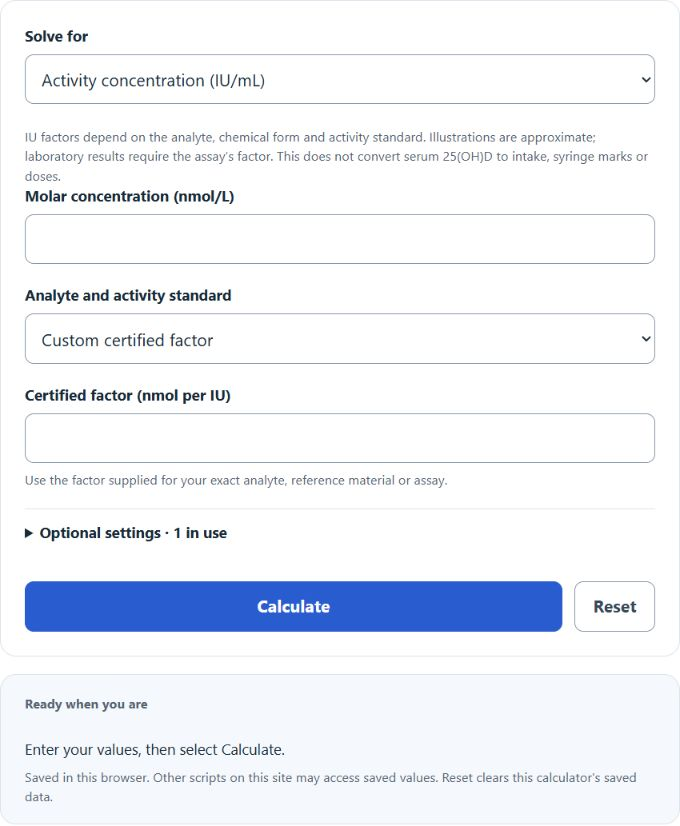
Convert nmol/L and IU/mL using a certified analyte-specific factor, infer a ratio from paired concentrations, or compare separately scoped illustrative factors. No universal IU conversion exists, and an inferred ratio does not certify a standard.
- All Unit Converters
- mg/l to mmol/l Converter
- molarity to osmolarity Converter
- mcg/dl to ng/ml Converter
- tirzepatide mg to units Converter
nmol/L to IU/mL Formula
The following formula is used to convert a concentration in nmol/L to IU/mL for a specific analyte.
Variables:
- IU/mL is the concentration in international units per milliliter
- NMOL is the concentration in nanomoles per liter
- NPIU is the number of nanomoles corresponding to 1 IU for the selected analyte
To calculate IU/mL, first divide the nmol/L value by 1000 to convert from liters to milliliters, then divide by the analyte-specific nanomoles-per-IU factor.
Illustrative nmol per IU Factors
The following approximate illustrations combine stated mass-per-IU conventions with molar mass. Vitamin forms and insulin assay standards matter: use your laboratory or reference-material factor for actual results. The converter defaults to an empty custom certified factor; these examples are explicit choices.
| Analyte | Approx. nmol per IU | 10 nmol/L in IU/mL |
|---|---|---|
| Vitamin D₃ (cholecalciferol), nutrient convention | 0.064996 | 0.153856 IU/mL |
| All-trans retinol, nutrient convention | 1.047297 | 0.009548 IU/mL |
| Free natural RRR-α-tocopherol, nutrient convention | 1555.571034 | 0.000006429 IU/mL |
| Pure human insulin, reference mass basis | 5.974518 | 0.001674 IU/mL |
What is nmol/L to IU/mL Conversion?
Nanomoles per liter (nmol/L) is a chemical concentration unit based on amount of substance, while international units per milliliter (IU/mL) is based on biological activity. Because an IU is defined separately for each vitamin, hormone, or compound, there is no single universal conversion between nmol/L and IU/mL. The correct result depends on the analyte and its official IU definition.
For example, the scoped vitamin D₃ illustration uses a smaller nmol-per-IU factor than the free natural vitamin E illustration. The same numeric nmol/L value therefore maps to different IU/mL values. This does not imply equivalent biological effects or interchangeable doses. Vitamin D₃ activity is not a conversion of serum 25(OH)D results to intake, and insulin immunoassays may require a different factor from the pure-insulin reference example.
How to Calculate nmol/L to IU/mL?
The following steps outline how to convert nmol/L to IU/mL.
- First, determine the concentration in nanomoles per liter (nmol/L).
- Next, identify the exact analyte, chemical form and activity standard, and obtain its certified nanomoles-per-IU factor. If using an illustration, confirm that its stated scope applies.
- Divide the nmol/L value by 1000 to convert the concentration to nmol/mL.
- Finally, divide that result by the analyte’s nmol-per-IU factor to find IU/mL.
- After inserting the values and calculating the result, check your answer with the converter above.
Example Problem :
Use the following variables as an example problem to test your knowledge.
Concentration (NMOL) = 10 nmol/L
Illustrative analyte = vitamin D₃ (cholecalciferol), using 1 IU = 0.025 µg and molar mass 384.64 g/mol
nmol per IU (NPIU) = 25 / 384.64 ≈ 0.06499584; this is an approximate nutrient-activity convention
IU/mL = (10 / 1000) / (25 / 384.64) ≈ 0.153856 IU/mL, or 0.1539 IU/mL rounded to four decimal places.
For this chemical form and nutrient convention, 10 nmol/L corresponds to approximately 0.1539 IU/mL. This is not a dosing calculation or a conversion of a serum 25(OH)D result.