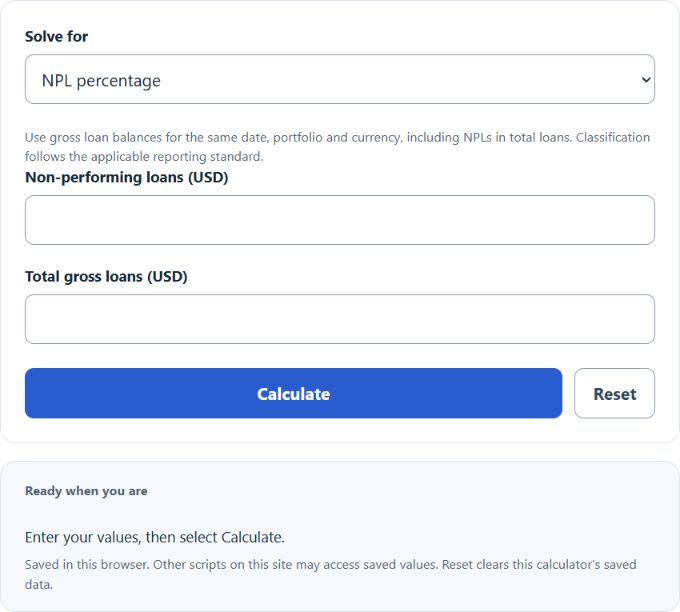
Calculate NPL percentage, non-performing loans, or total loans from any two inputs using the standard NPL formula for loan portfolios.
Related Calculators
- Cost Recovery Ratio Calculator
- Cost Income Ratio Calculator
- Promissory Note Value Calculator
- Clo Value Calculator
- All Business Calculators
NPL Percentage Formula
The following formula is used to calculate the NPL percentage for a given set of loans.
Variables:
- NPL% is the non-performing loan percentage
- NPL is the amount of non-performing loans
- TL is the total gross loan balance, including NPLs and before loan-loss provisions
To calculate the NPL percentage, divide the amount of non-performing loans by the total amount of loans. Multiply the result by 100 to convert it to a percentage.
What is an NPL Percentage?
The NPL percentage, or non-performing loan percentage, is a financial metric used to assess the quality of a bank's loan portfolio. It represents the proportion of loans that are in default or close to being in default. A high NPL percentage indicates a higher risk of loan losses, which can affect a bank's profitability and stability. This metric is crucial for banks, investors, and regulators to monitor and manage credit risk.
How to Calculate NPL Percentage?
The following steps outline how to calculate the NPL percentage.
- First, determine the amount of non-performing loans (NPL).
- Next, determine the total amount of loans (TL).
- Next, calculate the NPL percentage using the formula NPL% = (NPL / TL) * 100.
- Finally, express the result as a percentage of total loans.
- After inserting the values and calculating the result, check your answer with the calculator above.
Example Problem :
Use the following variables as an example problem to test your knowledge.
Non-Performing Loans (NPL) = $500,000
Total Loans (TL) = $10,000,000
NPL% = ($500,000 / $10,000,000) ×100 = 5%.