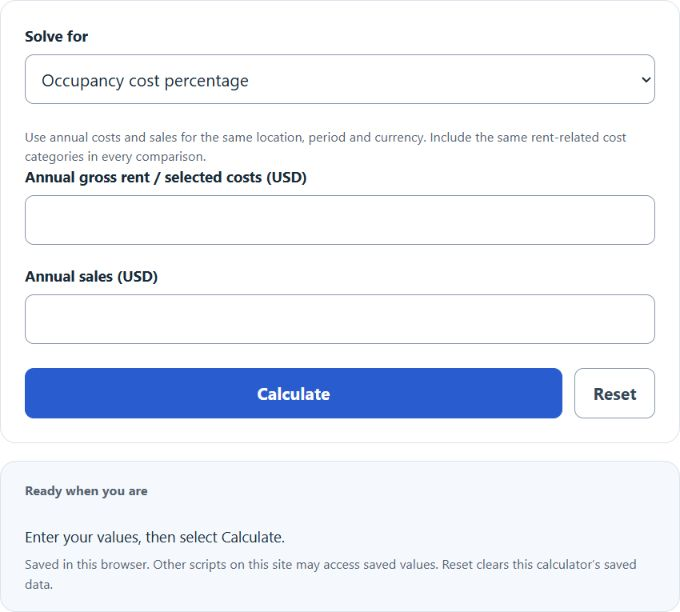
Calculate occupancy cost, annual gross rent, or annual sales from any two inputs using the occupancy cost formula in dollars and percent.
- All Cost Calculators
- Occupancy Rate Index Calculator
- All Business Calculators
- Max Occupancy Calculator
Occupancy Cost Formula
This calculator expresses supplied annual gross rent or selected occupancy costs as a percentage of matching annual sales. A broader occupancy-cost definition may include ancillary lease charges; apply one consistent scope. It is commonly used to evaluate location performance, compare lease options, set revenue targets, and determine whether a space is affordable for the level of sales it produces.
- OC = occupancy cost percentage
- GR = annual gross rent
- AS = annual sales
A lower occupancy cost generally means rent takes up a smaller share of revenue. A higher occupancy cost means more sales dollars are being used to support the space, which can put pressure on margins, staffing, inventory, and cash flow.
Rearranged Formulas
If you know any two values, you can solve for the third.
How to Calculate Occupancy Cost
- Determine the total annual gross rent for the location.
- Determine total annual sales generated by that location over the same time period.
- Divide annual gross rent by annual sales.
- Multiply the result by 100 to convert it to a percentage.
The key requirement is consistency: rent and sales must cover the same time frame. If rent is annual, sales should also be annual. If you are estimating from monthly figures, annualize both values before calculating.
Inputs Explained
| Field | What it Means | Practical Notes |
|---|---|---|
| Annual Gross Rent | The total yearly rent obligation for the space | Use a full-year amount. If your lease has seasonal or stepped rent, use the actual annual total for the period being analyzed. |
| Annual Sales | Total revenue produced by the location in one year | Use gross sales unless your business specifically tracks occupancy against another revenue measure. |
| Occupancy Cost | The percent of sales consumed by rent | This is usually used as a location efficiency and affordability metric. |
Examples
If annual gross rent is 900 and annual sales are 1800, the occupancy cost is 50%.
If annual gross rent is 3000 and annual sales are 10000, the occupancy cost is 30%.
You can also use the calculator to find the sales required to support a target occupancy cost. If annual gross rent is 72000 and you want occupancy cost to be 12%, required annual sales are 600000.
How to Interpret the Result
- Lower percentage: rent consumes less revenue, leaving more room for payroll, inventory, marketing, debt service, and profit.
- Higher percentage: rent consumes more revenue, which may indicate a weak location, soft sales, or an expensive lease structure.
- Changing over time: if rent is stable but occupancy cost rises, sales may be declining. If sales rise faster than rent, occupancy cost improves.
There is no single “correct” occupancy cost for every business. Acceptable levels vary by industry, product margin, lease structure, market, and how much foot traffic or prestige the location provides. A premium location can justify a higher occupancy cost if it supports stronger revenue and brand visibility.
What to Include in Annual Gross Rent
This calculator uses annual gross rent as the rent input. Depending on how your business tracks occupancy expense, you may include only base rent or a broader rent-related total. Use one consistent definition when comparing locations or periods.
- Base rent
- Fixed additional rent charges required by the lease
- Common area maintenance charges, if treated as occupancy expense internally
- Property taxes or insurance passed through to the tenant, if included in your rent analysis
- Percentage rent, if your lease requires it and you want a fuller occupancy view
If you are comparing multiple stores, make sure the same cost categories are included for each location. Otherwise, the percentages may not be comparable.
Common Uses of an Occupancy Cost Calculation
- Comparing two potential business locations
- Testing whether current sales justify the rent being paid
- Setting minimum annual sales goals for a new site
- Reviewing store performance during lease renewal discussions
- Budgeting for expansion, relocation, or downsizing
Common Mistakes
- Using monthly rent with annual sales, or annual rent with monthly sales
- Leaving out rent-related charges for one location but including them for another
- Using projected sales for one site and actual sales for another without labeling the difference
- Assuming a low occupancy cost always means a good site; customer quality, margins, and traffic still matter
- Analyzing one month in isolation when the business is seasonal
Tips for Better Analysis
- Review occupancy cost alongside gross margin, labor cost, and net operating profit.
- Track the ratio over time instead of using only one snapshot.
- Compare the same period year over year to identify real performance trends.
- For seasonal businesses, use trailing 12-month sales rather than a single month.
- When negotiating a lease, calculate the sales needed to reach a target occupancy cost before committing to the space.
Frequently Asked Questions
Is occupancy cost the same as rent?
Rent is a dollar amount. This calculator returns a rent-to-sales or selected-cost-to-sales percentage; broader occupancy costs may also include ancillary charges.
Why is occupancy cost important?
It helps show whether revenue is strong enough to support the location. It is a fast way to judge affordability and operating efficiency.
Can I use monthly numbers?
Yes, as long as both rent and sales are monthly. The formula works with any matching time period.
What happens if sales are very low?
Occupancy cost rises sharply because rent becomes a larger share of revenue. This often signals a location or sales-performance problem that needs attention.