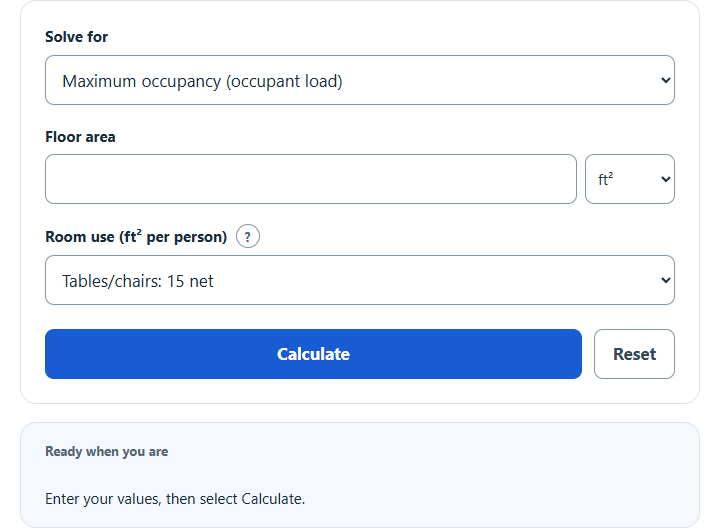
Calculate maximum occupancy for a room from its floor area in square feet or m² and its use, or find the floor area needed for a number of people.
- All Construction Calculators
- Occupancy Rate Index Calculator
- Vacancy Rate Calculator
- Occupancy Cost Calculator
Max Occupancy Formula
Variables:
- MO is the calculated design occupant load, rounded up to a whole person
- A is the applicable net or gross floor area (ft² or m²)
- UA is the applicable occupant-load factor in the same area unit per person
Divide the applicable floor area by the occupant-load factor and round upward to a whole person. Presets are selected examples from 2024 IBC Table 1004.5; confirm the adopted code, specific use and area definition with the local authority. Exits, fixed seating and other limits require separate review.
How to Calculate Max Occupancy?
The following steps outline how to calculate the Max Occupancy.
- First, determine the net or gross floor area required by the selected factor.
- Next, select the applicable factor using the same area units per person.
- Next, use MO = ceil(A / UA) for the area-based design occupant load.
- Finally, calculate the design occupant load; obtain local approval for permitted capacity.
- After inserting the variables and calculating the result, check your answer with the calculator above.
Example Problem :
Use the following variables as an example problem to test your knowledge.
area of the room (ft2) = 1,000
occupancy index (ft2/person) = 20
Frequently Asked Questions (FAQ)
What is an occupancy index and how is it determined?
The occupancy index is a measure of the amount of space allocated per person within a room or building, usually measured in square feet per person. It is determined based on building codes, safety regulations, and the intended use of the space.
Why is it important to calculate Max Occupancy?
The area-factor calculation helps estimate the design load used in building-code analysis. It does not by itself establish a safe or legally permitted maximum; exits, seating, layout, the adopted code and local approval also matter.
Can the occupancy index vary between different types of spaces?
Yes, the occupancy index can vary significantly between different types of spaces, such as offices, classrooms, and public venues, due to differing safety requirements, the nature of activities conducted, and the layout of the space.
How can changes in room layout affect Max Occupancy calculations?
A change in use or layout may change the applicable factor, net area, fixed seating or egress requirements. Gross and net area have distinct code definitions; do not automatically subtract furniture from a gross area. Have the local authority review permitted capacity.
Sources and verification: Preset factors were checked against 2024 IBC Table 1004.5. This is a design occupant-load calculation, not an approval to post a maximum occupancy. Local adoption and amendments can differ. 2024 IBC Chapter 10, Table 1004.5. Verified October 20, 2026.