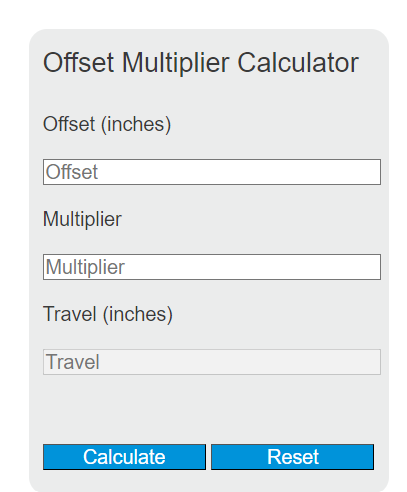
Calculate conduit offset multiplier, bend spacing, reverse offset or angle, second-mark position, and geometric shrink for common or custom equal bend angles.
- All Math and Numbers Calculators
- Offset Bending Calculator
- Rolling Offset Calculator
- Conduit Shrink Calculator
- 3/4 EMT Offset Calculator
- Pipe Slope Calculator
Offset Multiplier Formula
The offset multiplier is used to convert a desired offset into the travel needed to form that offset with two equal bends. In conduit, pipe, and tubing layout, the travel is the sloped centerline distance between the bends.
If you already know the travel or need to solve for the multiplier, the same relationship can be rearranged as follows:
- T = travel distance
- O = offset distance
- M = offset multiplier
The multiplier is unitless, so the offset and travel can be entered in inches, feet, millimeters, or centimeters as long as both values use the same unit.
How the Multiplier Relates to Bend Angle
For a standard equal-offset layout, the multiplier comes from the bend angle. Geometrically, the travel is the hypotenuse of a right triangle and the offset is the side opposite the bend angle.
This is why smaller bend angles require more travel, while larger bend angles require less travel.
How to Use the Calculator
- Measure the required offset distance.
- Select the bend angle you plan to use.
- Find the correct multiplier for that angle, or enter the multiplier directly if it is already known.
- Calculate the travel to determine the spacing needed for the offset section.
- Mark the conduit or pipe using that travel distance between equal bends.
Common Offset Multipliers by Angle
| Bend Angle | Multiplier | Typical Rounded Field Value |
|---|---|---|
| 10° | 5.7588 | 5.8 |
| 22.5° | 2.6131 | 2.6 |
| 30° | 2.0000 | 2.0 |
| 45° | 1.4142 | 1.4 |
| 60° | 1.1547 | 1.2 |
If precision matters, use the full decimal multiplier instead of the rounded field value.
Examples
6-inch offset with 30° bends: use a multiplier of 2.0, so the travel is 12 inches.
8-inch offset with 45° bends: use a multiplier of 1.4142, so the travel is about 11.31 inches.
4-inch offset with 22.5° bends: use a multiplier of 2.6131, so the travel is about 10.45 inches.
Practical Notes
- These formulas apply to equal-angle offsets, where both bends are made at the same angle.
- Do not mix units. If the offset is entered in inches, the travel returned will also be in inches.
- The multiplier only changes when the bend angle changes.
- Lower angles create smoother offsets but require more run length.
- Higher angles reduce travel but may be less desirable depending on space, bend radius, and installation standards.
Common Mistakes
- Using the wrong multiplier for the chosen bend angle.
- Confusing offset distance with travel distance.
- Rounding the multiplier too aggressively on tight-tolerance work.
- Applying the formula to unequal bends, where this simple relationship does not apply directly.
This calculator is most useful when you know any two of the three values: offset, travel, or multiplier. Enter the known values, and it quickly solves for the missing one so your layout is faster and more consistent.