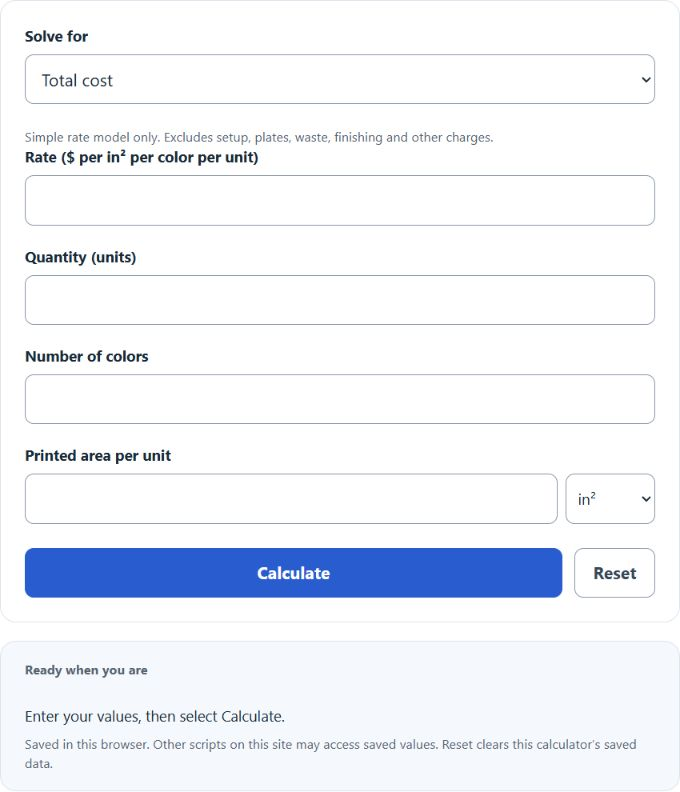
Calculate offset printing cost, rate, quantity, colors, or print area from any four values using price per square inch, units, and colors.
Related Calculators
- Price Per Piece Calculator
- Service Price Calculator
- Marginal Cost Calculator
- Cost Per Hour Calculator
- All Business Calculators
Offset Printing Formula
The following simplified formula is used by this calculator to estimate the cost of offset printing:
Variables:
- Cost is the total cost of offset printing ($)
- P is the rate in dollars per square inch per color per unit ($/(in²·color·unit))
- Q is the quantity of units (units)
- U is the number of colors used (colors)
- S is the area of the printed material per unit (in²)
To calculate the cost of offset printing using this model, multiply the rate (P) by the quantity (Q), then multiply by the number of colors (U), and then multiply by the area per unit (S) in square inches. If you enter area in cm², m², or ft², the calculator converts it to in² before calculating.
What is Offset Printing?
Offset printing (offset lithography) is a widely used printing process where ink is transferred from a flat printing plate to a rubber blanket, and then from the blanket to the printing surface. It is a planographic process: image and non-image areas are on the same plane, and printing relies on the chemical difference between them (image areas are ink-receptive/oleophilic, while non-image areas are water-receptive/hydrophilic). During printing, a dampening solution helps keep non-image areas free of ink, and the inked image is then offset to the blanket and finally to paper or another substrate. This method is known for high quality and consistency, especially for larger-volume print runs.
How to Calculate Offset Printing Cost
The following steps outline how to calculate offset printing cost using the formula above.
- Determine the rate P in $ per square inch per color per unit ($/(in²·color·unit)).
- Determine the quantity Q (number of units being printed).
- Determine the number of colors U used in the job.
- Determine the area per unit S (in²). If you have cm², m², or ft², convert to in² (the calculator will convert automatically if you select the correct unit).
- Calculate Cost = P × Q × U × S (or rearrange the formula to solve for the missing variable).
Example Problem:
Use the following variables as an example problem to test your knowledge.
P = 0.002 $/(in²·color·unit), Q = 500 units
U = 4 colors, S = 20 in² → Cost = 0.002 × 500 × 4 × 20 = $80.00