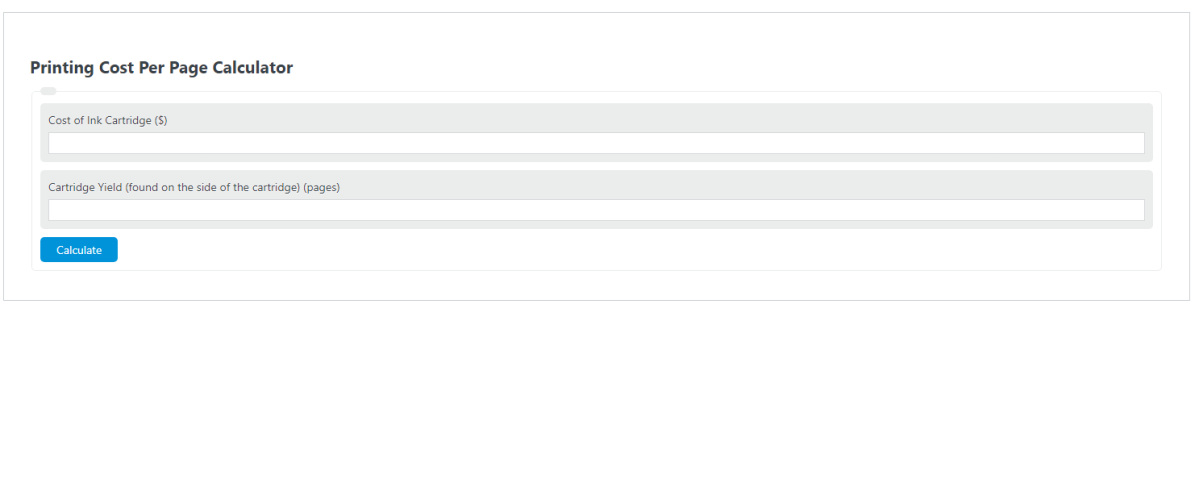
Calculate printing cost per page from cartridge price, rated page yield, page coverage and paper cost, plus monthly spend and printer break-even pages.
- MSI Calculator
- All Business Calculators
- GSM (Grams Per Square Meter) Calculator
- 3-D Print Time Calculator
- Cost Per Page Calculator
Printing Cost Per Page Formula
The following formula is used to calculate the basic printing cost per page.
- PCPP is the printing cost per page ($/page)
- CP is the cartridge cost ($)
- CY is the cartridge page yield (pages)
To include paper, use the full cost-per-page formula:
- PR is the paper ream price ($)
- S is the number of sheets per ream (typically 500)
CPP Benchmarks by Printer Type
Manufacturer page yields are tested at 5% page coverage under ISO standards. The ranges below reflect typical real-world CPP at standard office print density, including paper at roughly $0.01 per sheet:
| Printer Type | B&W CPP | Color CPP |
|---|---|---|
| Standard Inkjet | $0.05 - $0.10 | $0.15 - $0.25 |
| High-Yield Inkjet (XL) | $0.03 - $0.05 | $0.08 - $0.12 |
| Standard Laser | $0.05 - $0.08 | $0.12 - $0.20 |
| Business/High-Yield Laser | $0.02 - $0.04 | $0.07 - $0.12 |
| Supertank / EcoTank / MegaTank | $0.002 - $0.01 | $0.005 - $0.02 |
How Page Coverage Affects Real Yield
All manufacturer page yields are certified under ISO/IEC 19752 (monochrome) and ISO/IEC 19798 (color), which use a test page with only 5% of the area covered in ink or toner. That roughly equals a single-spaced business letter on a mostly blank page. Most real documents print at 10-40% coverage, cutting effective yield well below the rated number.
| Actual Coverage | Yield vs. Rated | Real Pages (2,000-page cartridge) |
|---|---|---|
| 5% (standard letter) | 100% | 2,000 |
| 10% (typical report) | ~50% | ~1,000 |
| 20% (mixed images) | ~25% | ~500 |
| 40% (graphics-heavy) | ~13% | ~260 |
To estimate real CPP at higher coverage, adjust the yield before dividing: Adjusted Yield = Rated Yield x (5 / Your Coverage %).
Laser vs. Inkjet: Break-Even Analysis
A lower CPP on a laser printer does not automatically mean lower total cost. The higher upfront hardware price must be recovered through per-page savings. The break-even point is the volume at which both options have equal total spend.
Example: A $250 laser printer at $0.04/page versus an $80 inkjet at $0.08/page. Break-even = ($250 - $80) / ($0.08 - $0.04) = 4,250 pages. Beyond roughly 4,250 total pages, the laser has the lower combined cost.
Definition
Printing cost per page (CPP) is the operating cost of printing one sheet, expressed in dollars. It is the standard metric used to compare printer economics across models and brands, and appears on cartridge packaging and in printer spec sheets. Basic CPP counts only ink or toner. Total CPP adds paper and, for laser printers, drum unit amortization. Service contract costs can be added for a fleet-level view.
Example
A toner cartridge costs $45 with a rated yield of 3,000 pages. Paper costs $8 per 500-sheet ream.
Ink CPP = $45 / 3,000 = $0.015 per page
Paper CPP = $8 / 500 = $0.016 per page
Total CPP = $0.015 + $0.016 = $0.031 per page (about 3.1 cents)
If those pages are printed at 15% coverage instead of the ISO 5% standard, effective yield drops to roughly 1,000 pages, raising ink CPP to $0.045 and total CPP to about $0.061 per page.