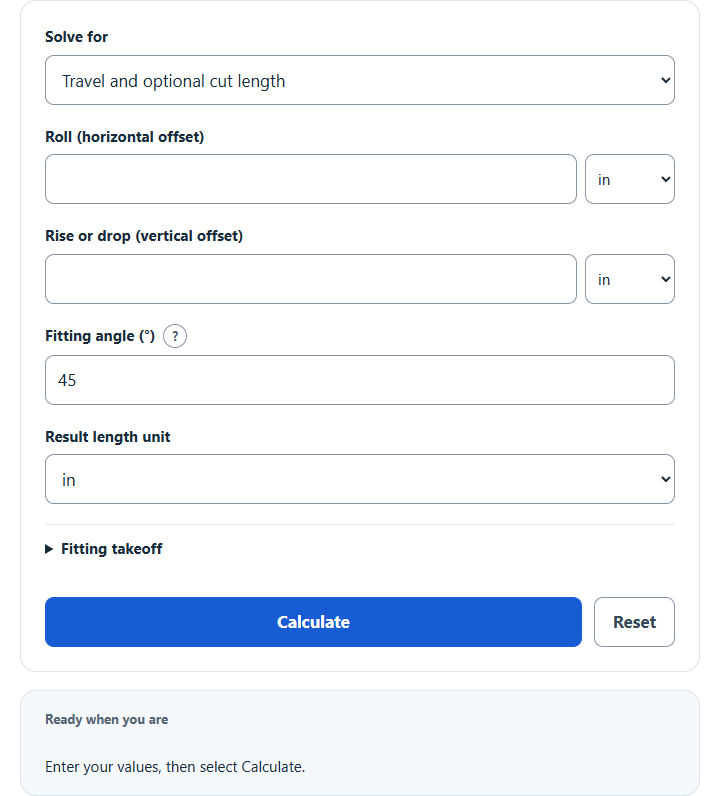
Calculate a rolling offset: enter the roll and rise to get the true offset, pipe travel and cut length for a 45°, 22.5° or any other fitting angle.
Rolling Offset Formula
For matching elbows connecting parallel pipe runs, first find the true offset from perpendicular rise and roll, then divide by the sine of the fitting angle for center-to-center travel. The BC plumbing apprenticeship geometry also gives advance as true offset divided by the tangent of the fitting angle. At 90°, travel equals true offset and advance is zero.
The reverse modes use rise = √((travel × sin(angle))² − roll²), or angle = asin(true offset / travel). A zero missing rise is valid when the remaining offset is positive. Twist is measured from the horizontal roll direction toward the vertical rise: 0° is horizontal and 90° is vertical. Rise and roll are magnitudes, so the calculation does not specify left/right clocking.
- Rise: vertical distance between pipe centerlines (or absolute difference of start and end elevations)
- Roll: horizontal offset between the two pipe runs measured in plan view
- Angle: matching elbow angle at both ends, greater than 0° and at most 90°; custom values describe geometry and do not identify an available fitting
- Travel: distance along the joining pipe between the theoretical intersections of the elbow centerlines
- Takeoff: effective deduction per end from the theoretical centerline intersection to the required pipe end; use the correct fitting and joint dimensions
- Cut length: estimated straight pipe end-to-end length after subtracting two equal effective takeoffs; this does not verify fit, pressure service or fabrication tolerances
Both elbows use the same angle and equal entered takeoffs. Enter rise or drop as a nonnegative magnitude. A blank takeoff leaves cut length unspecified; the design mode shows travel, while the inverse modes headline the requested rise or angle. An explicit zero makes the modeled cut length equal travel. A provided takeoff must leave a positive cut length. No weld gap, socket engagement, thread make-up, bend radius or clearance is added automatically.
Fitting Multipliers and Common Values
The travel multiplier is 1 / sin(angle). Use the table below to sanity-check the calculator output.
| Elbow Angle | Travel Multiplier | Notes |
|---|---|---|
| 11.25° | 5.126 | Long travel, gentle bend |
| 22.5° | 2.613 | Common for shallow offsets |
| 30° | 2.000 | Clean 2x of true offset |
| 45° | 1.414 | Most common rolling offset |
| 60° | 1.155 | Tight, near-square turn |
| 90° | 1.000 | Travel equals true offset |
There is no universal takeoff table based only on nominal pipe size and material. Obtain the dimension for the exact fitting model, angle, radius and end connection. For example, the Spears dimensional catalog distinguishes fitting dimensions, while the Pipe Trades Pro guide treats takeout and welder’s gap separately. Use an effective deduction consistent with the actual required pipe end.
- For socket or threaded fittings, account for the specified insertion or make-up when interpreting a center-to-face dimension.
- For butt-weld fittings, use the specified center-to-end takeout and account for the project’s weld gap separately or within a correctly combined effective deduction.
- Confirm fitting orientation, bend radius, engagement, clearances and installation tolerances before fabrication.
Worked Example
You need to route around an obstacle. The pipe must drop 12 inches and shift 16 inches sideways, using two 45° elbows.
- True offset = √(12² + 16²) = √(144 + 256) = √(400) = 20 in
- Travel = 20 / sin(45°) = 20 / 0.7071 = 28.28 in
- With a 1 in takeoff per fitting: cut length = 28.28 – 2(1) = 26.28 in
FAQ
Does it matter if the pipe rises or drops? Enter the magnitude as a nonnegative rise. Rise and drop give the same lengths, but physical orientation and left/right clocking still have to match the layout.
Can I use different angles at each end? No. This calculator assumes matching elbows. Mixed-angle layouts need a different geometric approach.
Why is a cut length unavailable? Leave takeoff blank when it is unknown. When a takeoff is provided, twice that effective deduction must be less than travel; otherwise no positive straight pipe length remains in this model. Check the exact fittings, units and joint allowances.
What is the difference between travel and true offset? True offset combines the perpendicular rise and roll between parallel runs. Travel follows the joining pipe between theoretical elbow-centerline intersections. Travel exceeds true offset below 90° and equals it at the 90° endpoint.